


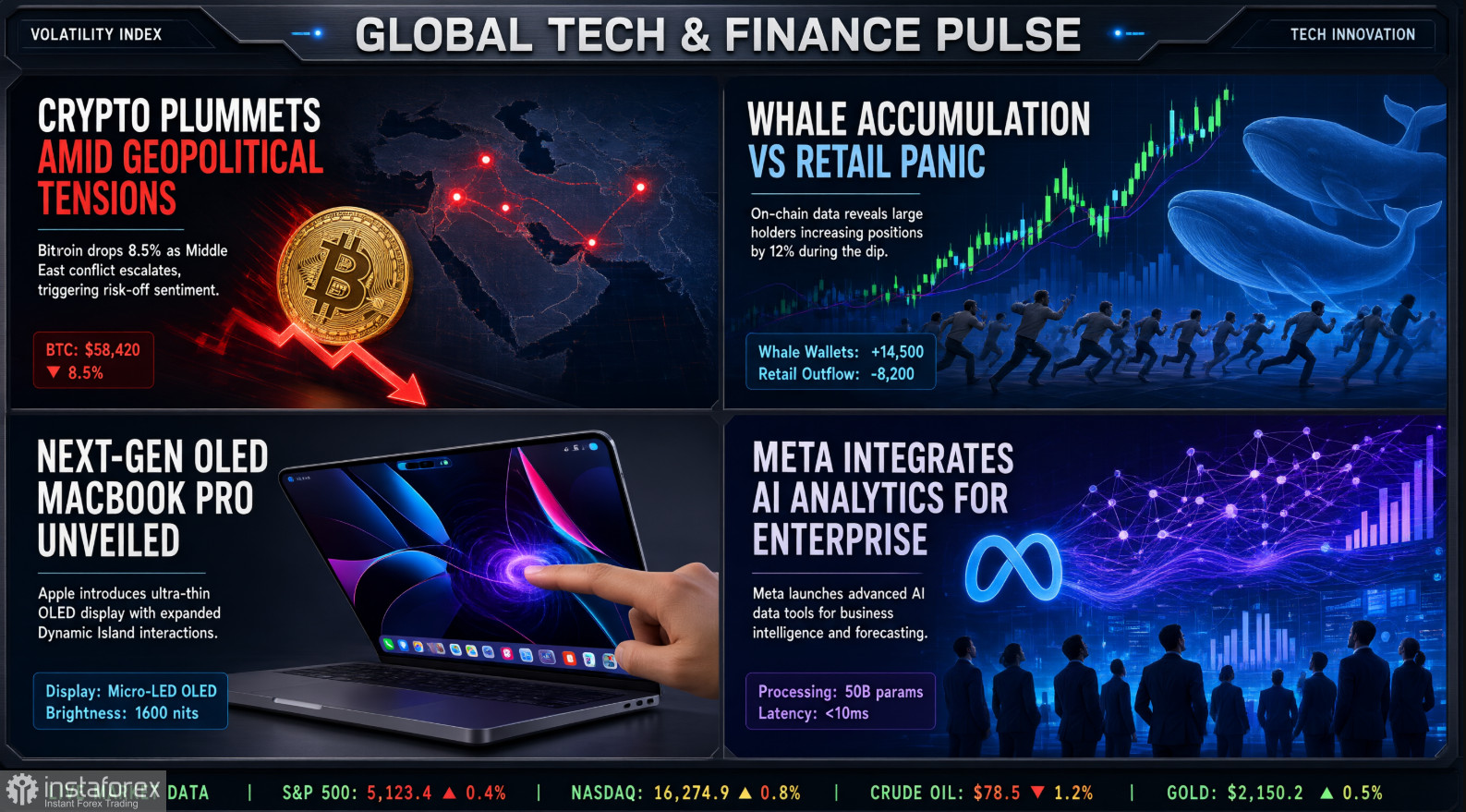
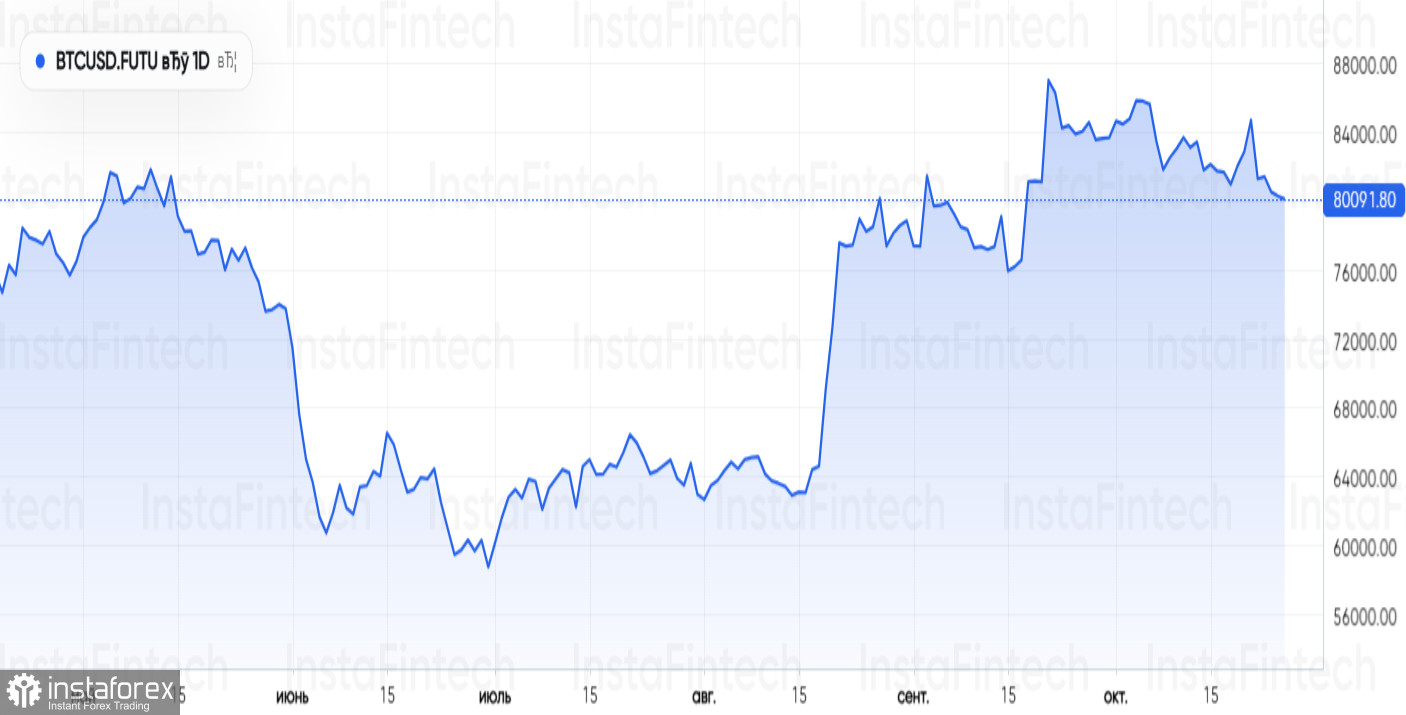
The news agenda over the past few days has been marked by sharp contrasts spanning financial and tech sectors. Geopolitical shocks, notably escalation in the Middle East and record oil prices, have put heavy pressure on crypto markets, pushing Bitcoin below $80,000.
At the same time, investor behavior is diverging: large institutional players are exercising discipline, while retail investors are more likely to lock in losses.
Tech is undergoing a rapid transformation. Apple unveiled its first MacBook Pro models with touch OLED displays, breaking its own product conventions, and Meta strengthened its AI foothold by acquiring startup Sundial and bringing back key personnel.
This note analyzes the political risks facing digital assets, explores why large and small investors behave differently, and evaluates the implications of Apple's and Meta's latest technology moves for end users.
Hormuz shock: Bitcoin drops below $80,000 amid threat of war with Iran

The crypto market experienced a genuine shock on Saturday, October 24. Bitcoin, the world's largest digital currency, fell below the psychological $80,000 mark for the first time in more than a month. The decline was the steepest since September 18 and inflicted heavy losses on leveraged longs.
BeInCrypto data shows that more than $200 million of margin positions were liquidated in a single hour; roughly $191 million of that sum came from longs. For many leveraged traders, the day resulted in material losses.
Why $80,000 matters
That level is not arbitrary. It roughly matches the average price at which corporate treasuries bought Bitcoin for their balance sheets. A drop below that threshold means institutional holders are, for the first time in a while, running at paper losses — a worrying signal for a market that has come to rely on corporate buying as a source of price support.
Trigger: the specter of major war
What sparked the sudden liquidation? CoinDesk analysts link the crash to a Wall Street Journal report that rattled global markets. The paper said the US was urgently evacuating personnel from embassies and military bases in the Middle East amid intelligence about planned Iranian attacks on US targets.
Tensions deepened after a note from Director of National Intelligence Jay Clayton circulated on Friday, warning that Iran has "substantially increased efforts to target US personnel."
President Trump's comments at a rally in Florida — "We may do another little Epic Fury" — were widely read as a hint that conflict with Tehran could escalate after the US midterms, adding to market nerves.
Oil record hits crypto
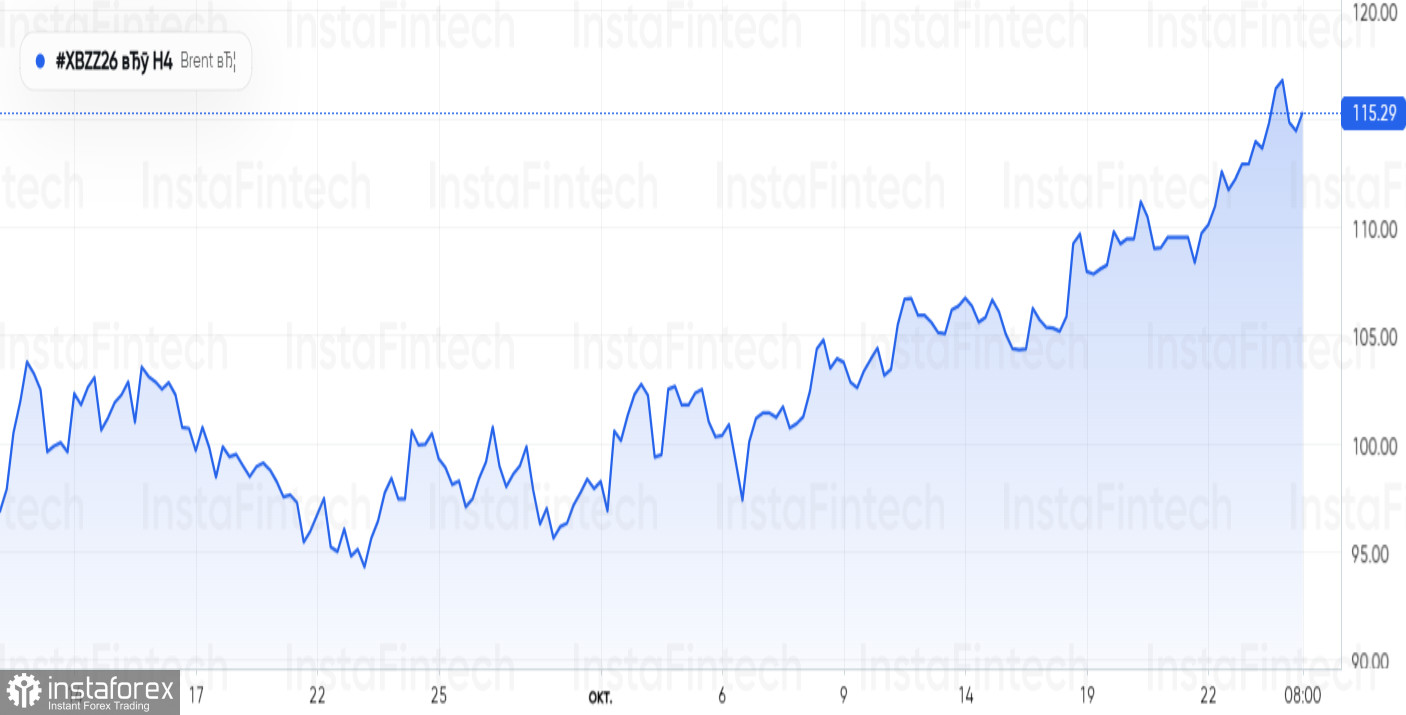
The geopolitical shock immediately hit commodities. On Friday, Brent crude closed at $116.72/bbl, the highest level in more than four years, per Trading Economics. Markets are pricing in the risk of US strikes on Iran, while Houthi attacks on Saudi infrastructure continue to threaten supply.
High oil prices directly pressure crypto. As Trending Topics notes, expensive energy fuels inflation and reduces the likelihood of rate cuts by central banks. Higher interest rates raise the opportunity cost of holding non-yielding assets such as Bitcoin and cool investor risk appetite accordingly.
Evidence of waning demand came via record outflows from US spot Bitcoin ETFs: on Thursday, investors withdrew $635.6 million, the largest single-day outflow since June.
Volatility is a constant of financial markets, especially during geopolitical crises, but such episodes also create opportunities for disciplined, risk-savvy traders who can react quickly.
All instruments discussed, including cryptocurrencies and commodities, are available on the InstaForex platform. To respond to market moves in real time, consider opening an InstaForex account and downloading the mobile app to monitor positions and execute trades from anywhere.
Bitcoin at crossroads: retail investors sell while whales wait
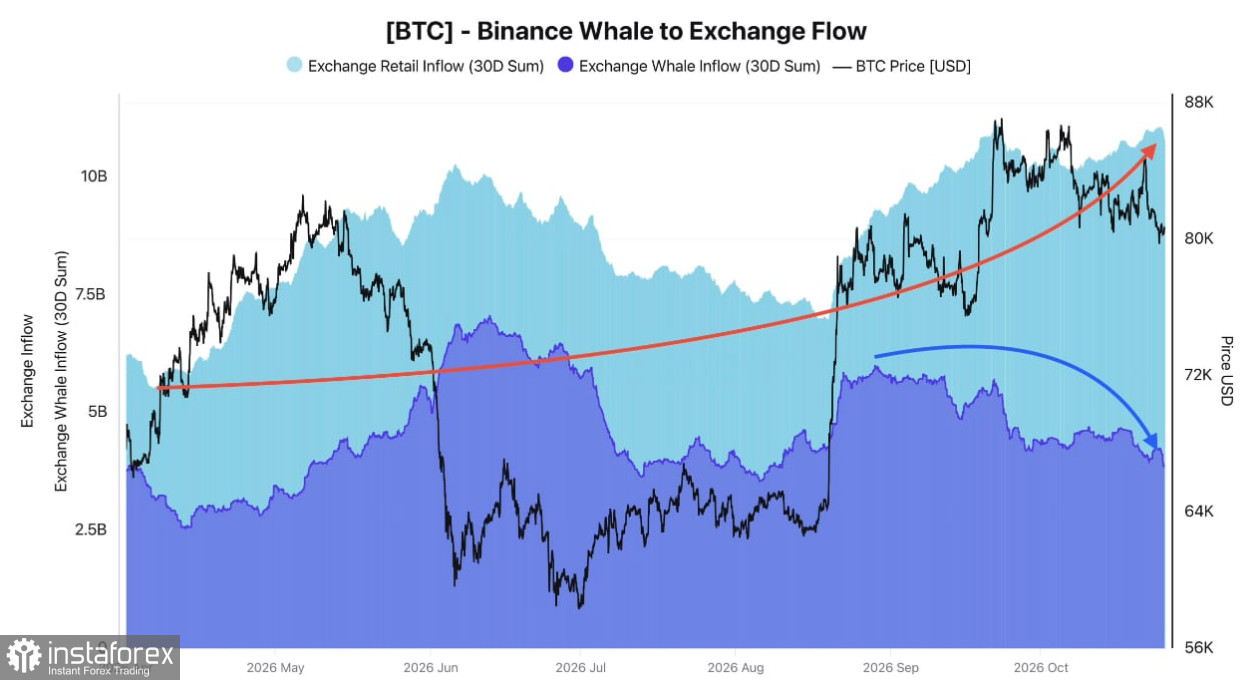
The crypto market is replaying a classic script: retail holders rush to lock in profits while large players, the so-called "whales," are in a wait-and-see mode.
This dynamic is clear from fresh data published by CryptoQuant analyst Darkfost on X on October 25.
Retail investors double down on exit
The numbers speak for themselves: over the last 30 days, cumulative retail deposits on Binance jumped from $5.5 billion in April to $10.75 billion, nearly double. At the same time, whale deposits to exchanges fell from $5.9 billion at the end of August to $3.8 billion.
The divergence became particularly evident after Bitcoin spent several weeks above the psychological $80,000 mark. Retail deposits now exceed whale deposits by roughly 2.8x, with an absolute gap of about $6.95 billion.
Who's right: sellers or patient accumulators?
Darkfost argues that retail behavior is understandable: ordinary holders see the recent price bounce as an opportunity to exit after almost a year of sideways to lower prices. In plain terms, retail traders see a "window to sell" and are rushing through it.
Whales are following a very different playbook. Their reluctance to move coins onto exchanges suggests that they do not plan to sell at current prices. Analysts characterize these large holders as patient market participants who currently see no reason for a broad liquidation.
It is important to note that moving coins onto an exchange does not necessarily equal an immediate sell. Depositing assets simply places them on a venue where trading happens — interpreting every inflow as an imminent dump is an assumption, not proof. Also, 30-day aggregates smooth single-day spikes in activity.
The 36% drop in whale deposits since late August does signal a slowdown in their on-chain activity, but it does not mean they are out of the market. A $3.8 billion monthly inflow from whales is still substantial. And remember: these figures cover Binance only — flows on other exchanges may tell a different story.
Context: elevated market fragility
This trend aligns with earlier on-chain signals. In the weeks before October's US inflation print, whales were increasing balances. But 24 hours after the release, Bitcoin fell by 3.3%, and whale deposits have not shown growth since.
The situation is compounded by broad market weakness: over the past 24 hours, Bitcoin fell along with most major cryptocurrencies — 67 of the top 90 tokens declined — indicating a wide corrective move across the crypto market.
Touch revolution: Apple breaks its own taboo with first OLED MacBook Pro
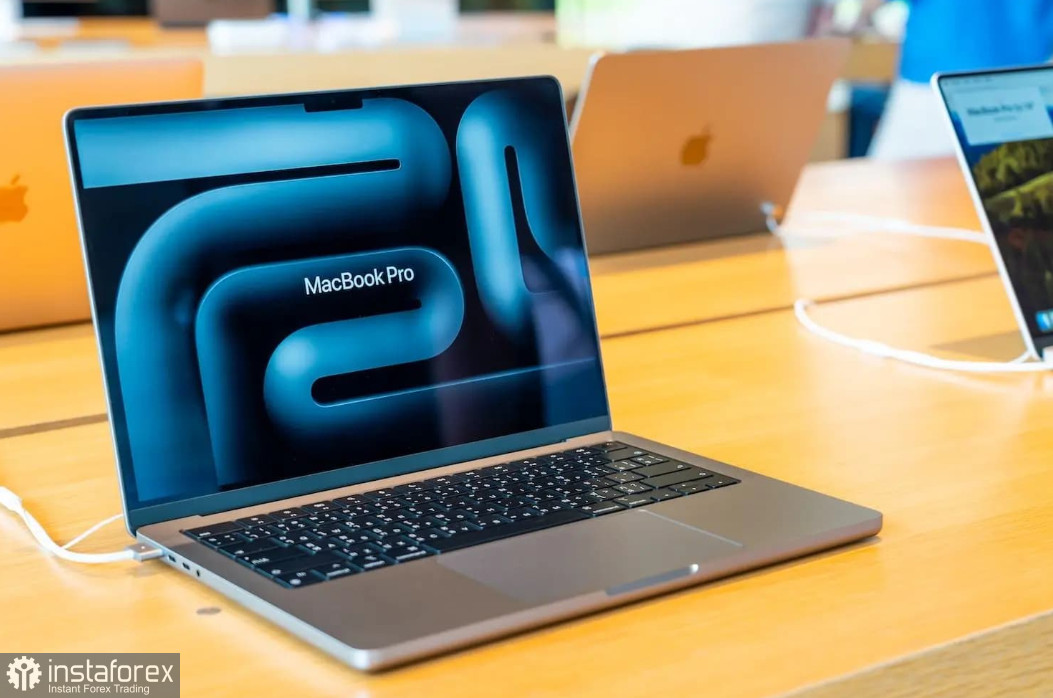
On October 28, 2026, Apple unveiled 14- and 16-inch MacBook Pro models featuring revolutionary touch-enabled OLED displays. The company that for years insisted touch belonged on iPad, not Mac, is finally changing course.
End of an era of conservatism
Apple's long-standing philosophy was simple: laptops are for keyboard and trackpad input; touch was for tablets. That barrier is now being torn down.
The new MacBook Pros are the first Macs to support touch input, marking a meaningful strategic shift and opening a new era in user interaction with the computer.
The announcement came at the "Pro and Tell" event in Los Angeles, which began at 10:00 a.m. Pacific. As usual, Apple's invites (sent October 19) were coy, but Reuters and Bloomberg analysts expected the headline product to be a touch-enabled MacBook Pro. Attendees were able to try devices immediately after the presentation.
Specs and pricing
Externally, the new models preserve the familiar MacBook Pro design but are noticeably lighter. The notch is gone; instead, the laptops use the Dynamic Island UI element that iPhone users already know.
Under the hood are Apple's latest M5 Pro and M5 Max chips introduced in March; a base 14-inch model with an M6 processor is expected to sit at the bottom of the line, according to 9to5Mac.
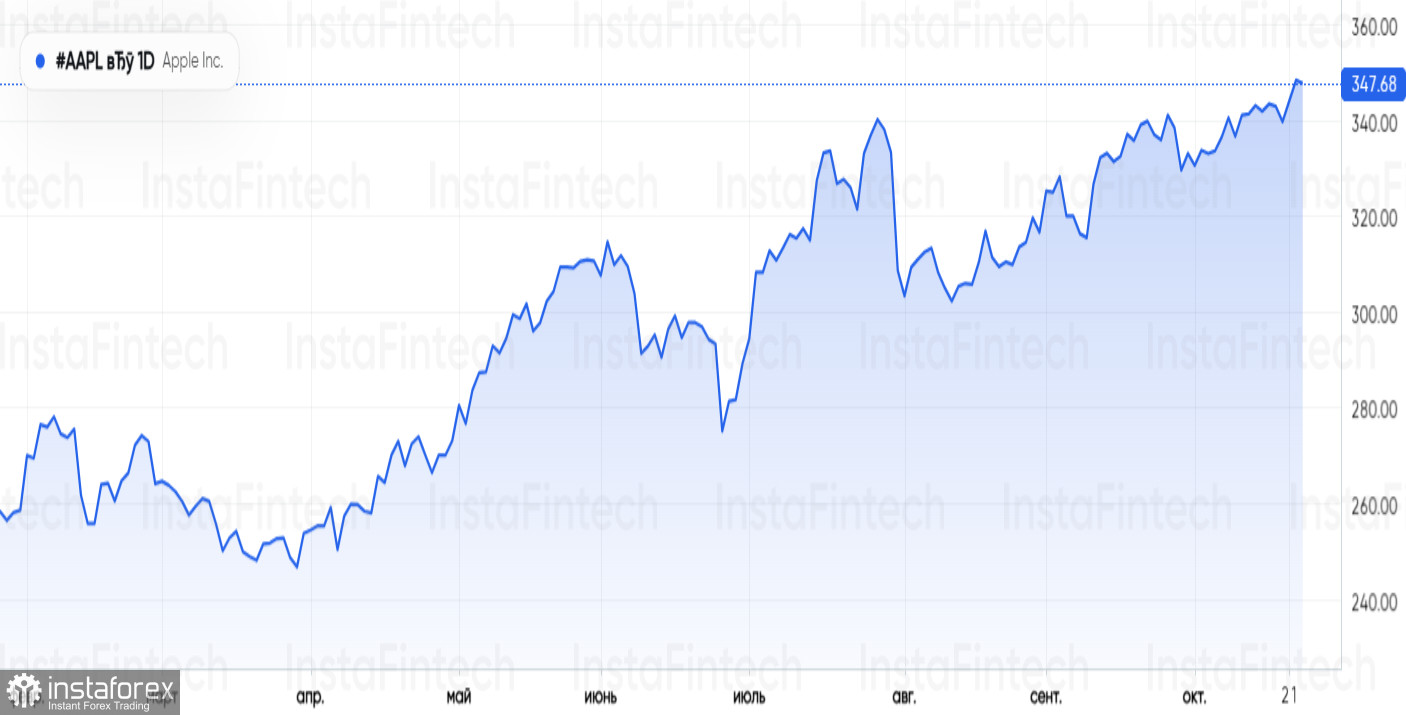
The headline hardware change is the display: Apple is shifting from mini?LED to OLED. That brings deeper blacks, far higher contrast, and improved energy efficiency.
Progress won't be cheap. Current mini-LED MacBook Pros start at $2,499 for 14-inch devices and $2,999 for 16-inch. MacRumors estimates that OLED variants could carry about a $500 premium; Bloomberg's Mark Gurman warns buyers to expect "significantly higher" pricing. Apple will continue to sell mini-LED models for now, but production is likely to wind down over time.
MacOS Golden Gate: an interface that understands you
The software side is arguably the most interesting part of the move. MacOS Golden Gate introduces a dynamic interface optimized for touch.
The OS will be context-aware: it will detect whether you are using a trackpad or touching the screen and adapt controls accordingly. Imagine contextual menus that appear around your finger, and a Dock and menu bar optimized for touch. This is not merely adding a feature — it is a rethink of the entire user experience.
Meta acquires startup founded by former executives for undisclosed sum

Meta Platforms has officially announced the acquisition of Sundial, a promising AI-driven data analytics platform, notably founded by two former Meta veterans who are now returning to the company's fold.
Axios first reported the deal and confirmed it with the company. The setup is straightforward: Sundial will cease servicing external clients and be folded into Meta's analytics organization. In short, Meta is doubling down on in-house analytics to meet rapidly growing data demand driven by the AI push.
Who's behind the deal?
Along with Sundial's assets, several key people are moving back into the Zuckerberg empire. Co-founders Julie Zhuo and Chandra Narayanan, plus part of their team (many of whom are ex-Facebook and Instagram employees), will rejoin Meta.
These are well-known names to insiders:
- Julie Zhuo formerly served as VP of Product Design at Meta.
- Chandra Narayanan led analytics at Instagram and Facebook and earlier worked at Sequoia Capital.
- Alex Schulz, who will head the new unit, says Narayanan will run data analytics tools and AI agent integration.
Financial terms were not disclosed, which has only heightened industry interest.
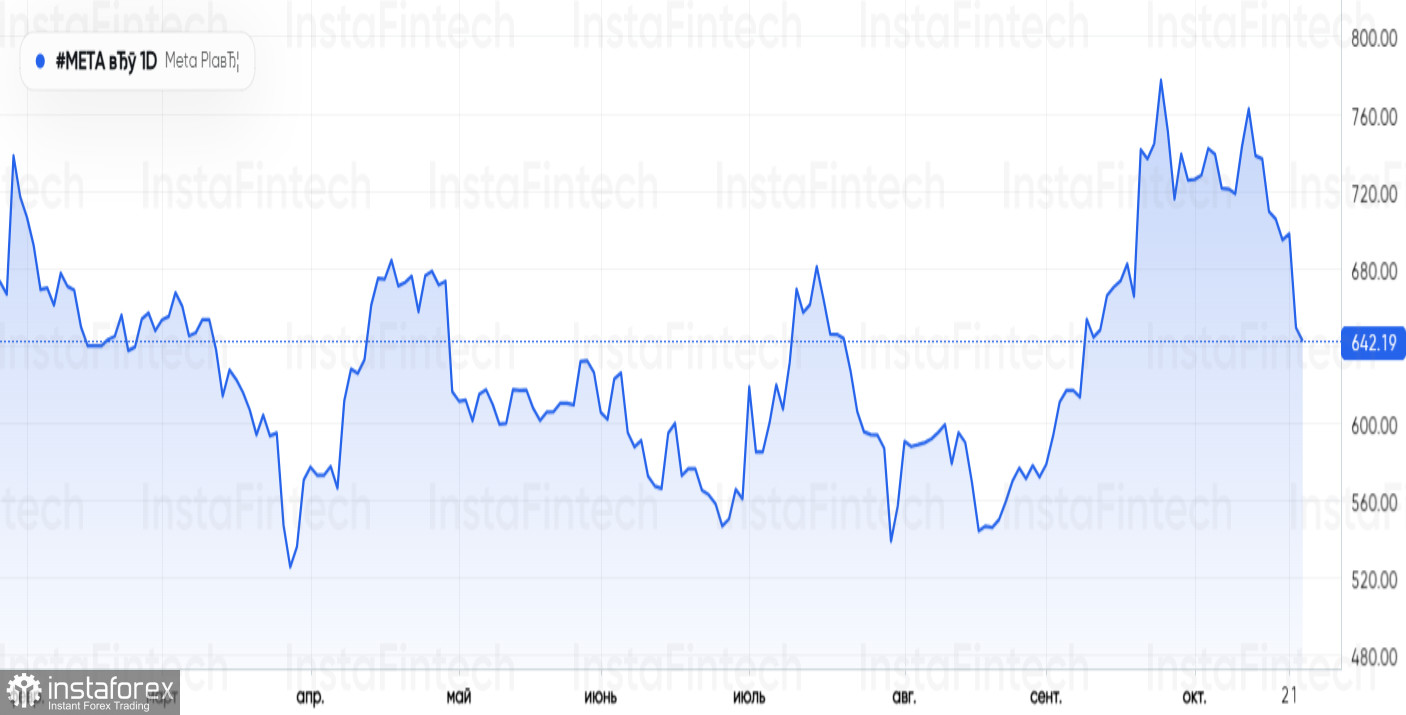
How the technology works
Sundial's platform converts human-language questions into actionable analytics via a chatbot plugin. The value proposition is simple: democratize data. Teams can run analyses themselves instead of waiting for centralized data squads. The system automates routine work — data cleansing, semantic-layer construction, and even composing complex SQL queries.
Investors back the idea
Before the acquisition, Sundial raised about $23 million in venture funding. A $16 million Series A round was led by DJ Patil (GPV partner and the US government's first Chief Data Scientist). The cap table also included Sequoia Capital, Slow Ventures, and Electric Capital, with angels among the founders of Shopify and Dropbox.
Why this matters for markets
These technologies change the rules in the data economy, and they have direct market implications. Better, faster analytics can accelerate monetization of AI initiatives and shift competitive dynamics across cloud, SaaS, and advertising ecosystems — all of which matter for relative equity valuations in tech. Investors will watch closely for signs that Meta is using Sundial to reduce time-to-insight on ad targeting, creator tools, and enterprise AI products.
The trading instruments referenced in this report, including major tech stocks, sector ETFs, and related FX pairs, are available on the InstaForex platform. To act on these structural shifts, open an InstaForex trading account and download the mobile app to trade quickly and stay ahead of market moves.


