


The Federal Reserve announces its rate decision today, but for crypto, the Fed's rhetoric matters more than the actual rate. Markets put roughly an 88.4% probability on a hold in the 3.75–4.00% range and about an 11.6% chance of a hike. A pause in October is widely expected by economists, with a hike penciled in for December. That difference between October and December will drive Bitcoin's reaction as it is trading near $80,000 and is headed for roughly a 4% monthly decline.
Major banks split into camps, but the nuance is critical. Goldman Sachs expects a pause now and a lift in December, viewing the Fed's approach as a compromise of intermittent hikes. Citigroup also sees a 25-bp move in December, followed by a pause. Bank of America stands apart: it expects a 25-bp hike today, arguing that price pressures have worsened since September. Traders, however, are focusing less on the headline rate and more on how hawkish Kevin Warsh sounds about further tightening.
For crypto, the transmission is straightforward. Oil near $110 feeds inflation, a hawkish Fed tone lifts yields and the dollar, while risk assets lose appeal. Bitcoin remains a risk asset holding in many funds. Ether typically reacts more strongly given higher volatility and weaker ETF inflows. The Fear & Greed index sits near neutral at about 48 — not overheated, but not brimming with optimism either.
The first scenario is hawkish. If Warsh explicitly signals that a December hike is essentially a done deal and hints at further tightening in the months ahead, yields would rise, the dollar would strengthen, and Bitcoin and Ether are expected to fall. For Bitcoin, the first downside target would be about $79,000, then $78,000 — where large protective options cluster — and then the $76,540 level that Galaxy calls a "red line." Ether could sink to about $2,300 and test $2,276. Note that the price reaction will likely come after Warsh's comments rather than after the rate decision itself.
The second scenario is dovish. If Warsh emphasizes a data-dependent approach, avoids committing to December, and acknowledges downside risks to markets and the economy, pressure on yields would ease, and crypto would have a chance to rally. Bitcoin could return toward $83,000 and test the weekly high near $85,000, and Ether could reclaim $2,400. ETF demand would help this outcome — funds already showed inflows after soft news before. Recall that Warsh said on October 16 he does not pre-decide meetings; the market will test that line today.
In my view, the hawkish scenario is more likely. The pause is already priced in the market, and a December hike is broadly expected by economists. Warsh has little incentive to calm markets amid elevated inflation and high oil prices. Since the December move is largely priced in, I would not expect a deep crash. Most likely, Bitcoin will fall initially toward $79,000 after the Fed, and holding that zone would signal that sellers have exhausted themselves ahead of key tech earnings.
Technical analysis and recommendations
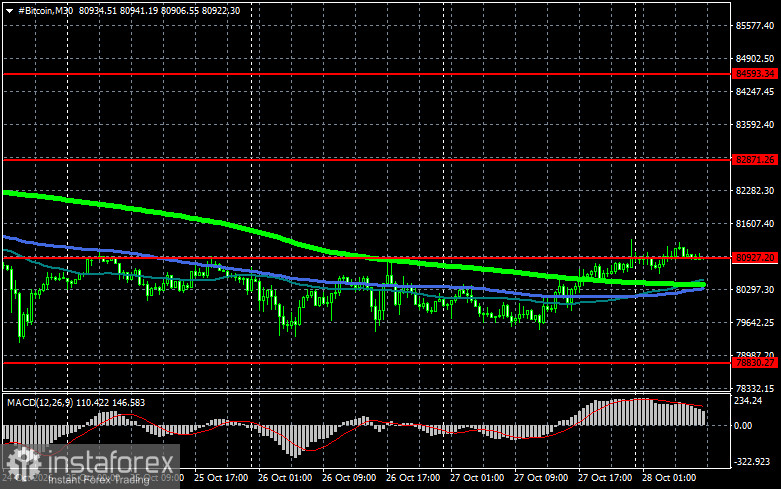
Bitcoin
Buyers target a return to $80,900, a level that opens a path to $82,800 and then $84,500, clearing which would suggest attempts to restore the bull market. On the downside, I expect buyers to defend near $78,700. A break below that area could push BTC quickly toward $76,900; a deeper target would be $75,300.
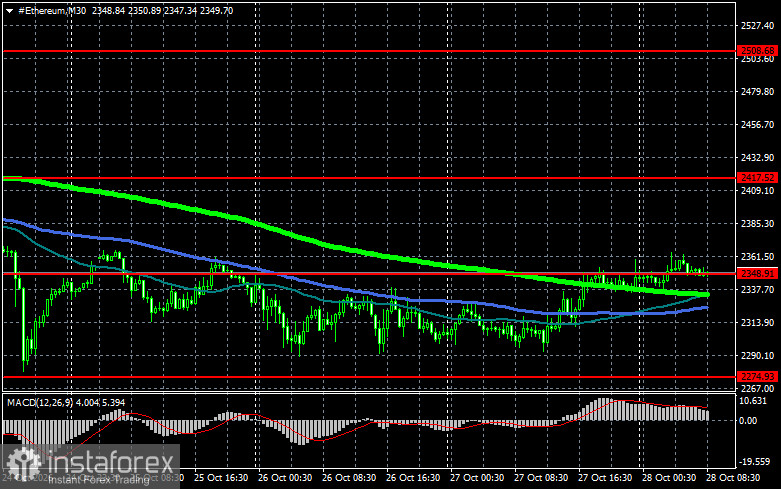
Ethereum
Consolidation above $2,348 would open a direct path to $2,417, with the next target around $2,508, a break above which would confirm renewed bullish sentiment and return buyer interest. On the downside, look for support near $2,274. A break and hold below that level could drive ETH toward $2,231. A further downside target would be $2,184.
What's on the chart:
- Red: support and resistance levels where the price is expected to slow or accelerate.
- Green: 50-day moving average.
- Blue: 100-day moving average.
- Light green: 200-day moving average.
Crosses of, or the price tests of, these moving averages typically either arrest moves or set the next market impulse.


