


UK economic data disappointed today, and the pound responded with a decline. The pair fell to 1.3295, but sellers made no further progress, and by midday the price had recovered to 1.3316. All three lending indicators came in below forecasts, and when several weak readings are released in succession, the market has little doubt about which direction the pressure is building.
Let's start with mortgage lending. The number of mortgage approvals fell to 53,400 in September, compared with a forecast of 54,000 and 54,800 in the previous month. Mortgage approvals are considered one of the most sensitive indicators of the housing market, as they show whether people are willing to buy homes when interest rates are high. Another decline suggests that elevated borrowing costs continue to deter buyers. Net lending to individuals came in at £5.8 billion, below the forecast of £6.2 billion and the previous reading of £6.9 billion. This indicates that UK households borrowed considerably less than usual.
The M4 money supply measure showed the weakest results. M4 refers to the broad money supply, or the total amount of money in the economy. It increased by just 0.1% month over month, compared with a forecast of 0.3% and a previous reading of 0.4%. On an annual basis, growth slowed to 3.9% from 4.5%. Money is accumulating more slowly, and banks are lending more cautiously. This combination of figures prompted the pound's decline. The data is unlikely to be decisive for the Bank of England, but it adds weight to concerns about excessive monetary tightening.
In the second half of the day, US economic data will be the main focus for the pound. The first estimate of US GDP for the third quarter will be released, with a growth forecast at 3.2%, up from 2.2% in the second quarter. This would represent a notable acceleration of almost one percentage point. The core Personal Consumption Expenditures (PCE) price index for September will follow, with forecasts of 0.3% month over month and 3.1% year over year, compared with previous readings of 0.2% and 3.0%. This index is an inflation measure closely watched by the Fed. The picture will be rounded out by consumer spending, forecast to rise by 0.6% after 0.9%; personal income, expected to increase by 0.3% after 0.2%; and weekly initial jobless claims, forecast at 199,000, up from 194,000. If GDP exceeds estimates and the price index comes in above expectations, the dollar will likely continue to strengthen, making it difficult for the pound to hold its ground. The market is partly prepared for a strong reading, as Warsh has already hinted at one, but a genuine surprise could force traders to reassess their positions.
Momentum
GBP/USD
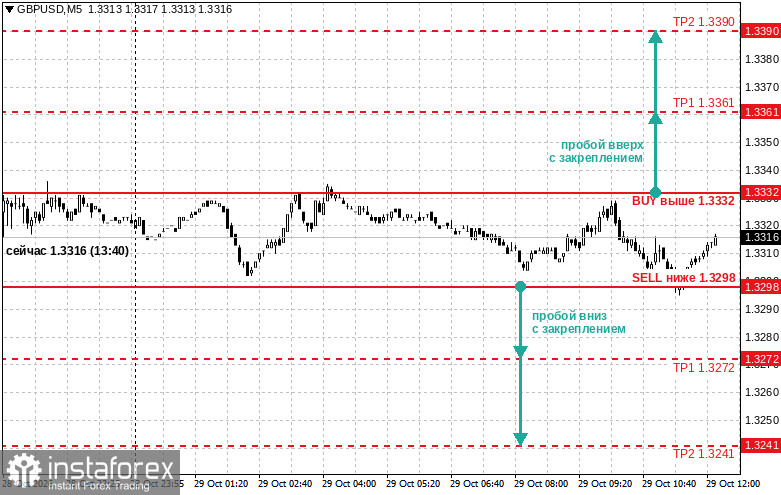
The pair is currently trading at 1.3316, roughly midway between the two breakout levels. The upper level of 1.3332 is 16 points away, while the lower level of 1.3298 is 18 points away.
The key downward level is 1.3298. A break below it, followed by consolidation, could send the pair toward 1.3272 and then 1.3241. Today, the price already fell to 1.3295, three points below this level, before recovering. The initial move therefore did not confirm a breakout. A genuine breakout requires the price to hold below the level, and this is more likely if US GDP comes in stronger than expected. This is the primary scenario, given the weak UK data and the potential for the dollar to gain support.
The upward reference level is 1.3332. A breakout above it would open the way toward 1.3361 and 1.3390. Overnight, the pair briefly moved above this level, reaching 1.3335, but failed to hold there and retreated. The upward scenario would therefore require weaker-than-expected US GDP data.
Mean Reversion
GBP/USD
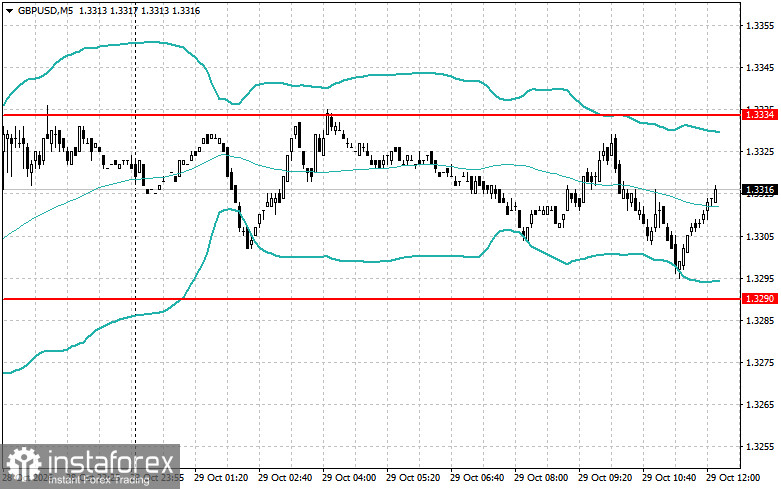
The upper reference level of 1.3334 is just two points above the breakout point at 1.3332, so particular caution is needed here. Two points fall within normal market noise, making it impossible to distinguish a breakout from a reversal based on a single test. If the price moves above 1.3332, reaches 1.3334, and consolidates above it, this confirms a breakout, and selling should be avoided. If the price briefly moves higher but fails to hold above the level and quickly falls back below 1.3332, this indicates a reversal. In that case, short positions could be considered, with a stop-loss above the highest point reached during the failed attempt. The overnight move followed this pattern: the pair rose to around 1.3335 before quickly retreating.
The lower reference level of 1.3290 is eight points below the breakout level of 1.3298. It becomes relevant if a downward breakout begins but the price extends too far and loses momentum. If the pair falls to 1.3290, fails to continue lower, and recovers above 1.3298, long positions could be considered, with a stop-loss below the low of the failed move. Today's low of 1.3295 did not reach this reference level, so it has not yet been properly tested. However, if the price moves through 1.3290 without difficulty and remains below it, the reversal scenario is invalidated, opening the way toward 1.3272. The ECB decision and US GDP release could trigger sharp moves in the pair this evening, so it is better to avoid rushing into trades and wait for the initial market reaction to settle.


