


The pound rose yesterday even though the U.S. GDP report looked impressive and, by ordinary logic, should have supported the dollar. The pair reached about 1.3405, then pulled back and now trades near 1.3382. The reason is that beneath the headline growth number, the market saw a weak spot — the U.S. consumer.
GDP in Q3 grew 3.4% year-on-year versus a 3.2% forecast and 2.2% in Q2. But consumers were noticeably weaker than the economy. Real spending in September was almost unchanged, and real disposable income — income after adjusting for price increases — fell for the first time since April. That implies households are sustaining spending out of savings, and such a buffer is not endless. Prices also failed to give the dollar clear support. The Federal Reserve's preferred gauge, PCE, is 3.6% year-on-year versus the 2% target, but the September print did not exceed forecasts; the 0.5% monthly rise was the fastest since March. At the press conference, Kevin Warsh emphasized the economy's strength and the fight against prices, and investors still price in a December rate hike. The policy rate itself remained in the 3.75%–4.00% range; the decision was 10-2.
This background matters for the pound because U.K. domestic news yesterday was not great. Lending data missed forecasts, and Chancellor John Healey's budget passed without surprises. At the September Bank of England meeting, six MPC members voted for a pause and three for a hike, showing there is no unanimity on rates yet. The next decision is November 5; the current rate is 3.75%, and U.K. inflation in September was 3.5%.
Today the U.K. calendar is almost empty. The only notable release is Nationwide's October house-price index. It's an early read for the housing market because Nationwide tracks mortgage application prices and publishes ahead of others. The consensus expects a -0.2% monthly change (same as last month) and a slowdown to +0.6% year-on-year from +0.8%. That is not a cause for alarm, as these figures are largely priced in, but if the annual rise outstrips forecasts or the monthly decline proves smaller than expected, the pound would gain fresh upside impetus.
Housing interest is elevated right now. Mortgage approvals for September came in at 53.4k versus a forecast of 54.0k, and net lending to individuals was £5.8bn versus a forecast of £6.2bn. A persistently weak housing market would fuel concerns that tightening is too aggressive, while a disappointing Nationwide print would heighten them. I believe strong housing figures would let GBP/USD stay higher, while weak data would push the pair back toward recent lows.
Momentum
For the pound, the price is now at 1.3382. Above, the breakout level at 1.3404 sits about 22 pips away. A break and hold above that level could push the pair to 1.3437 and then 1.3467. Overnight, the pair approached that zone twice, reaching roughly 1.3405, but failed to hold and fell back, so I do not count the initial touch as a confirmed breakout. For a genuine breakout, we would need either a strong Nationwide print or dollar weakness after the European inflation releases. Below, the reference is 1.3364, about 18 pips away. A break and hold below that would open the way to 1.3331 and 1.3298. That would be the scenario for a shift in dollar sentiment, and given today's backdrop, I am slightly biased toward upside, but the upper boundary is stubbornly holding the pair for now.
Mean Reversion
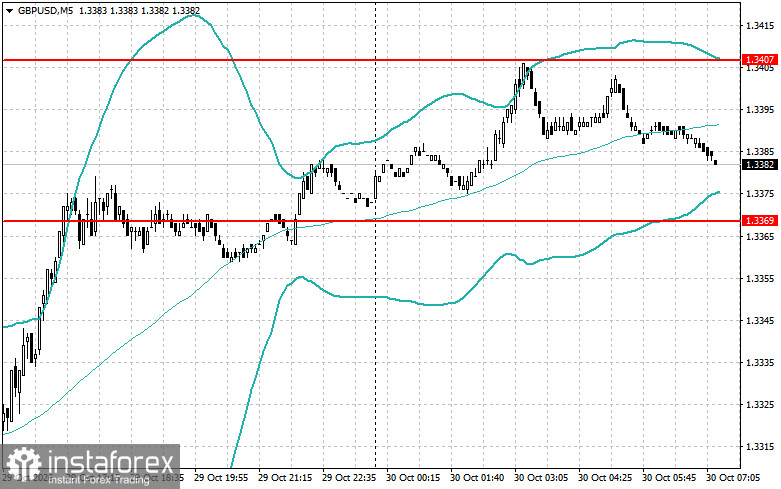
Upside reversion level: 1.3407, only three pips above the breakout point 1.3404, so extra care is required. Three pips is market noise, and on the first touch you cannot distinguish a breakout from a reversion. If price clears 1.3404, reaches 1.3407, and decisively holds above, that is a confirmed breakout and selling is off the table. If it merely probes above, fails, and quickly returns below 1.3404, the reversion plays, and I would look to sell with a stop above the high of the failed attempt. Overnight action looked exactly like that: the pair nearly reached the upside anchor, then retreated.
The downside reversion level at 1.3369 sits five pips above the breakout level at 1.3364, so caution is needed here as well. If price falls to 1.3369, breaks 1.3364, and holds below, that is a downside breakout, and buying is off the table. If it merely touches the zone and quickly returns above, the reversion works, and I would consider buying with a stop under the low of the failed attempt. The pair hasn't tested this area since yesterday evening, so the reaction could be stronger than usual. Skip the initial reaction in both zones and wait for clarity — and be especially careful with stops around the European inflation releases.


