


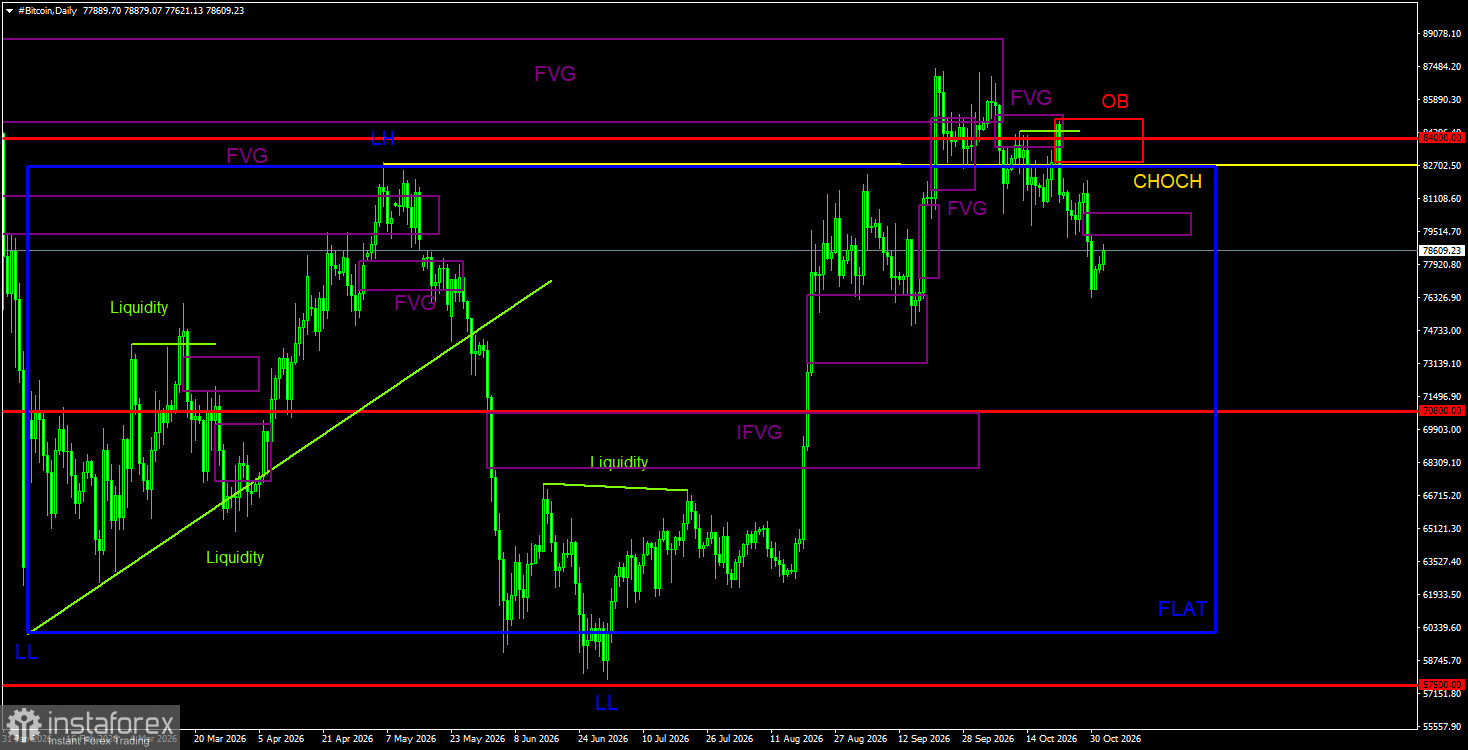
Bitcoin and Ether are continuing a downward move that keeps being fed by fresh negative headlines. Recent developments in crypto have been broadly adverse. Central banks—notably the Fed—continue to tighten monetary policy, which raises demand for safe assets rather than Bitcoin. The Clarity Act remains only a bill; if Democrats win the U.S. Congressional elections, there is a strong chance it will never become law. Historically, Bitcoin has fallen after U.S. midterm elections. This week added the hack of the world's largest crypto exchange, Binance, to that list. Taken together, the fundamentals for further growth in the crypto market remain, to put it mildly, doubtful. We do not deny that the asset can rally in any news environment—the recent dollar rally proves that—but at present there are no technical signals or fundamental reasons to expect a sustainable rise.
Many crypto experts warned at the end of September that October would bring a powerful market rally because October is traditionally considered favorable. Bitcoin rose in 10 of the last 13 Octobers, so this year it supposedly had to do the same. Based on a four-year cycle, many traders also expected the downtrend to end this autumn—simply because Bitcoin must move according to a four-year cycle, not a five-year one. Last month traders could see how well those "historical patterns" work.
A similar situation may unfold in November. We have noted that over the last 12 years, Bitcoin has always fallen after U.S. midterm elections. That could be coincidence, but we believe it is not. Midterms always mean partial changes in power and therefore shifts in overall policy. For example, Republicans led by Donald Trump are generally crypto-friendly, arguing that the U.S. should not lag other countries in developing the sector. Democrats, by contrast, view some Trump era crypto proposals as driven by the president's personal interests. Thus, a Democratic victory would make the outlook for the U.S. crypto sector materially more constrained.
Trading recommendations for BTC/USD:
Bitcoin attempted to start a new uptrend, but the fundamental backdrop, spot demand, and recent news are too weak to count on continuation. On the daily timeframe, Bitcoin may remain in decline because the price reacted to the two recent bearish FVGs and formed a bearish order block. A break outside the sideways channel on the daily chart is currently interpreted as a deviation. As a result, Bitcoin generated a reversal signal and is heading toward $70,800. Because a flat does not guarantee the end of the primary trend, we do not believe the bearish trend is over. Short positions are the most relevant in the near term.
Trading recommendations for ETH/USD:
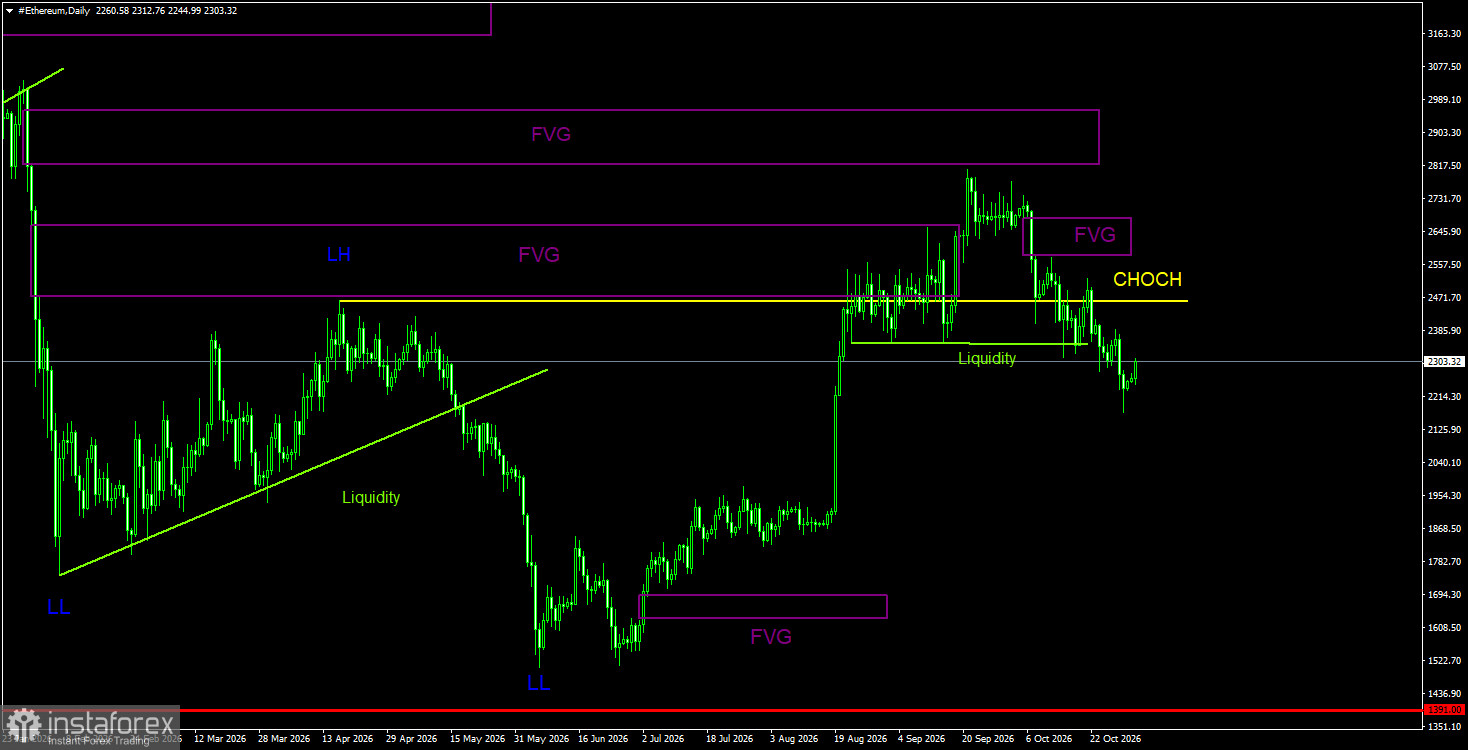
The daily technical picture for Ether has changed. Ether made a significant upward move in June–September 2026 that could be the start of a new long-term trend. However, confidence that Bitcoin's bear market is finished is absent. If Bitcoin remains in a downtrend or even a flat, Ether's rise should not be expected. Bulls can rely only on the weekly chart, where Ether is heading to $4,800—the upper boundary of a five-year sideways channel. On the daily timeframe, Bitcoin has formed enough sell signals and bearish patterns to continue falling. Therefore, we also expect Ether to decline, with targets near $1,850 and $1,391.
Notes on illustrations:
- CHOCH—change of structure (trend break).
- Liquidity—liquidity, stop losses, and pending orders that market makers use to build positions.
- FVG—fair value gap. A price-inefficiency area that price traverses quickly, indicating the absence of one side of the market; price tends to return and react to such areas in continuation of the main trend.
- IFVG—inverted fair value gap. After returning to such an area, the price often does not react but impulsively breaks through and then tests from the other side.
- OB—order block. The candle where a market maker opened a position aiming to take liquidity to form a position in the opposite direction.


