


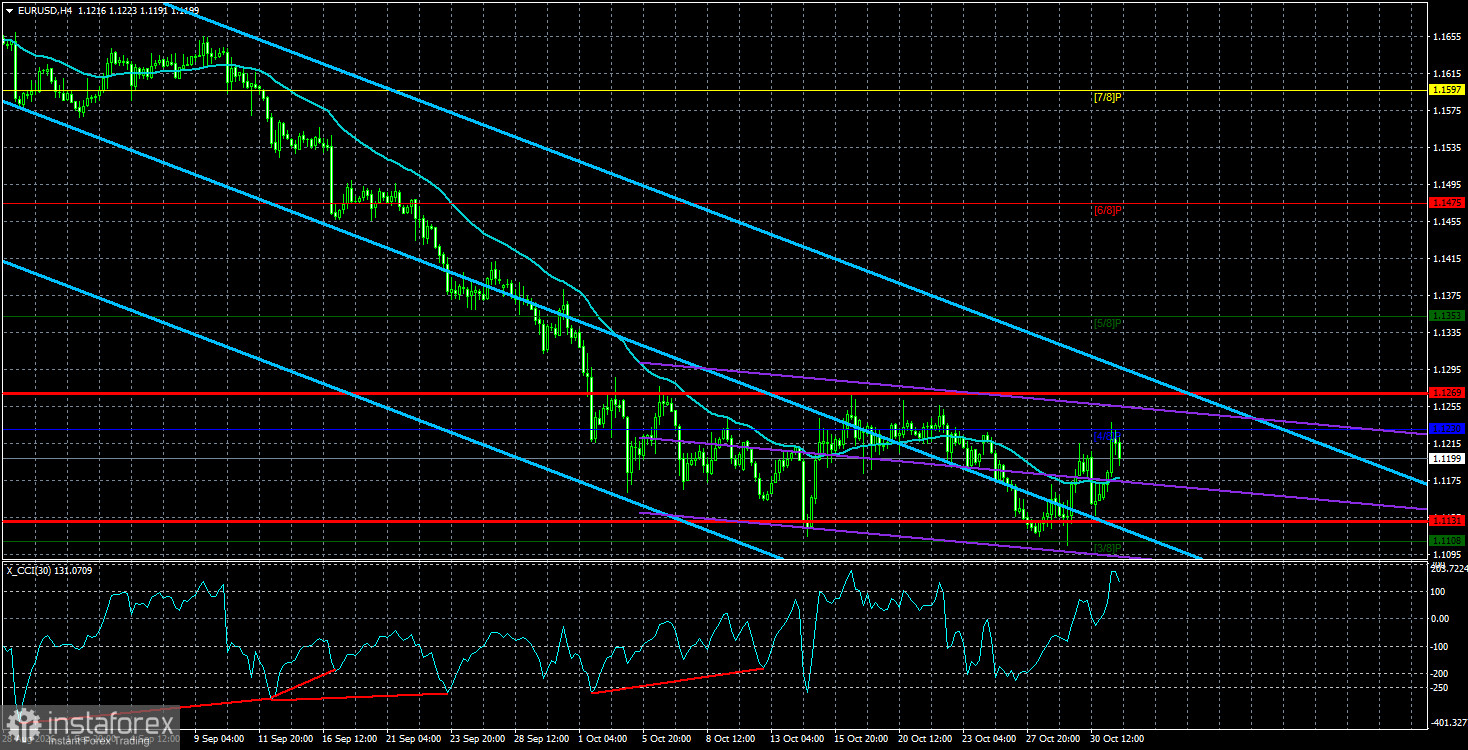
The EUR/USD currency pair showed decent gains on Monday morning, but this strengthening does not open any additional prospects for the European currency. Recall that the euro has every reason to rise against the dollar even without support from the US elections or labor-market and unemployment data. The euro has been falling for more than two months and during that time has not managed to show a meaningful correction. So, at least technically, it has grounds for growth.
But what growth can we speak of if the market refuses to lock in profits on short positions and open longs? Remember, fundamentals, geopolitics, macroeconomics, and other factors influence exchange rates only if the market itself wants to notice them. If there is no such desire, we will not see a regular movement. A vivid example is the European Central Bank's policy tightening in 2026. This year the ECB has already carried out two rounds of tightening and is preparing for a third in December. Yet only the dollar is rising, while the euro falls like a stone thrown off a cliff.
Even economists and analysts have stopped talking about factors such as rate hikes in the euro area. In principle, every day you can read the same thing in the media: "The French budget and unrest in EU countries weigh on the euro." How long will pressure based on this factor persist, and why are other factors not taken into account? No one wants or can answer this question. The market has found a convenient justification for what is happening, and whether that is actually the case interests no one.
Thus, the euro effectively remains at the "bottom," and what would be needed for even a correction is unclear. Most experts expect another dollar rise this week because "the Democrats will win the elections, the US labor market has begun to recover, and Donald Trump is about to start a new military campaign in the Middle East." Explanations have been found, so dollar buying can continue.
As for the US congressional elections, we expect no reaction to this event. First, when did the market last react to a change of power in any country? Second, the market cares about concrete changes in policy or the economy, not the mere fact that Democrats or Republicans won. If the Democrats win a landslide, at most they will complicate Donald Trump's life in the last two years of his final presidential term. Any decision passed by both chambers the president can "veto." If Congress does not support a decision, the president can try to enact it by executive order. Thus US policy will not fundamentally change, regardless of how many parliamentary seats the Democrats win.
In our view, speculative and inertial movement in the EUR/USD pair persists. The dollar rises because it is being bought, and it is bought because it rises. Note that against the British pound, the US currency has been falling in recent weeks. Is the French crisis to blame again?
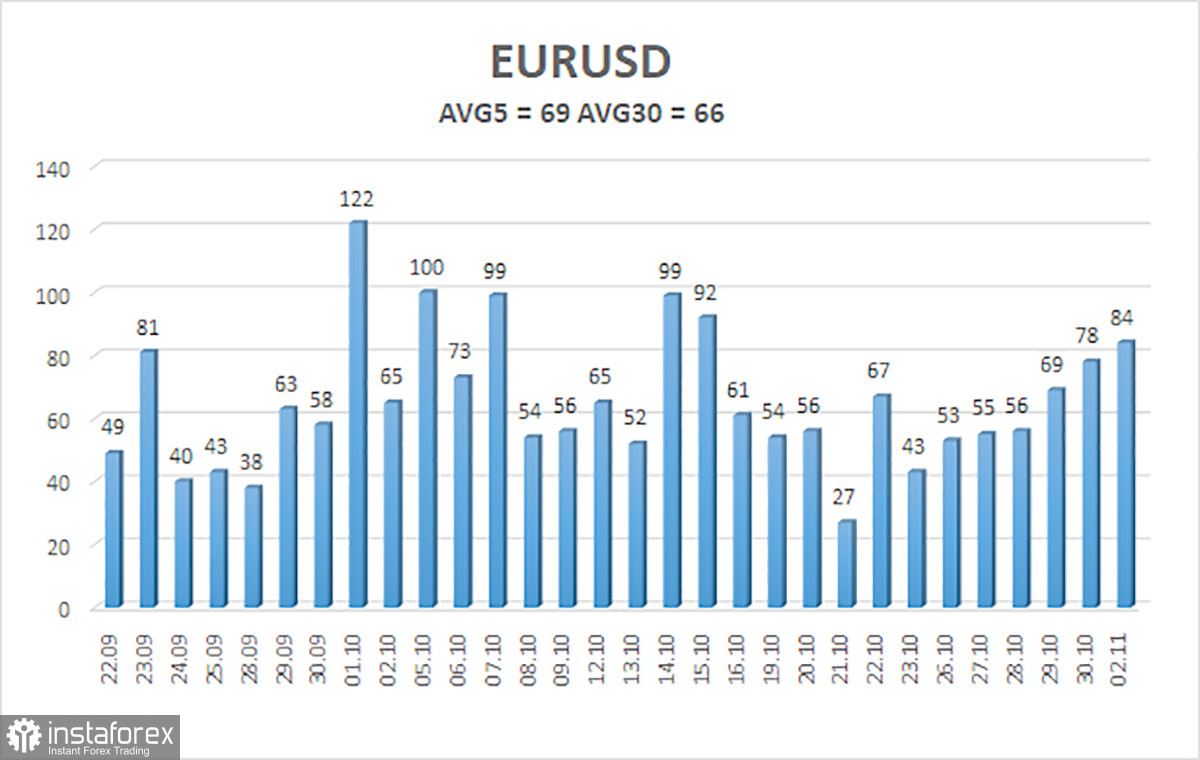
The average volatility of the EUR/USD pair over the last 5 trading days as of November 3 is 69 pips and is characterized as "average." We expect the pair to move between 1.1131 and 1.1269 on Tuesday. The major linear regression channel has turned down, indicating another trend change. The CCI entered the oversold area five times and formed four "bullish" divergences, but traders ignored all these signals. The illogical decline continues.
Nearest support levels:
S1 – 1.1108
S2 – 1.0986
S3 – 1.0864
Nearest resistance levels:
R1 – 1.1230
R2 – 1.1353
R3 – 1.1475
Trading recommendations:
The EUR/USD pair continues to move downward, but we still view the pair's decline as a correction before a new upward trend. The global fundamental backdrop for the dollar remains negative, but in 2026, geopolitical factors first, and then the Federal Reserve's hawkish stance, provided strong support for the US currency. When the price is below the moving average, consider short positions with targets of 1.1131 and 1.1108. Above the moving average, long positions are relevant, with targets of 1.1269 and 1.1353.
Notes on the charts:
- Linear-regression channels help identify the current trend. If both channels point the same way, the trend is strong.
- The moving average (settings 20,0, smoothed) defines the short-term tendency and the direction in which you should trade now.
- Murray levels are target levels for moves and corrections.
- Volatility levels (red lines) indicate the likely price channel the pair will inhabit over the next day based on current volatility.
- CCI indicator — entries into the oversold area (below -250) or overbought area (above +250) suggest a trend reversal may be imminent.


