


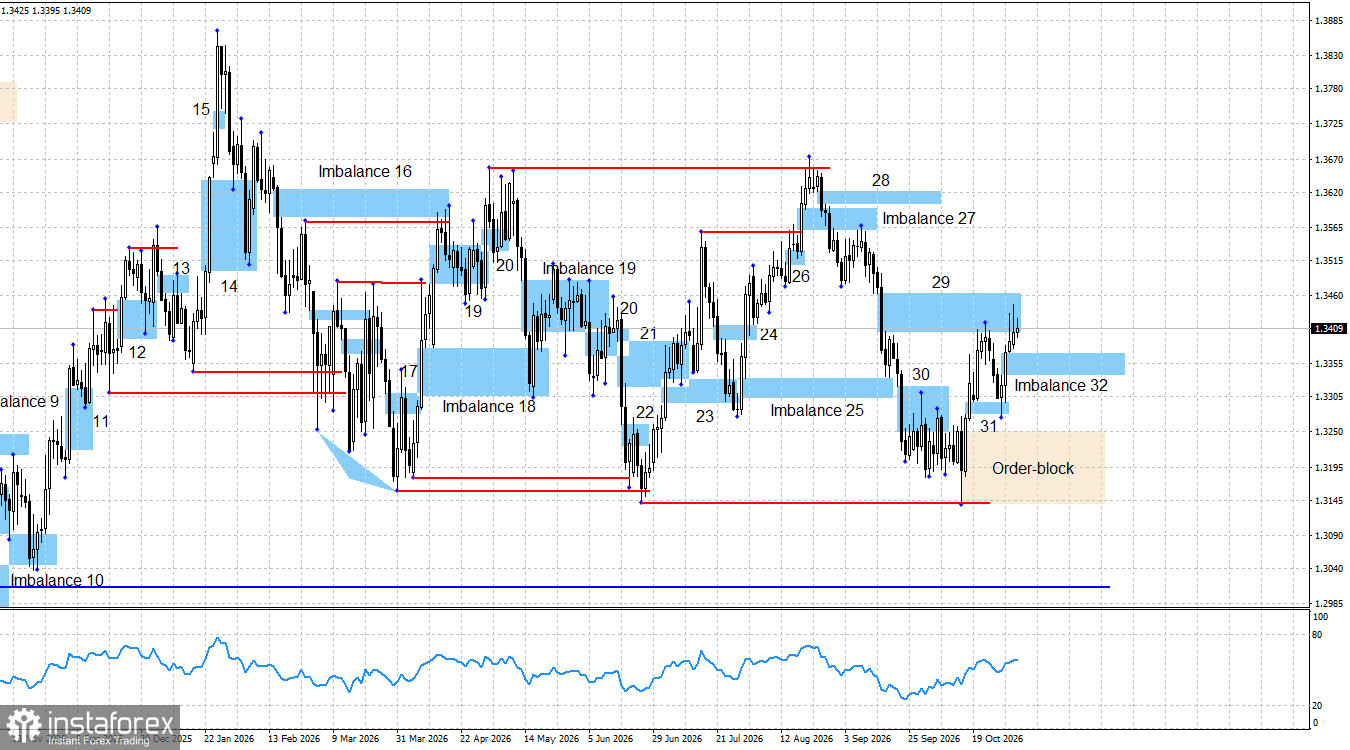
GBP/USD has made significant progress toward establishing a new bullish impulse within its annual range. Liquidity was swept below the June 24 low, allowing the bulls to launch their first attack. This was followed by a reaction to the bearish imbalance at level 29, a corrective pullback, a test of the bullish imbalance at level 31, a reversal in favor of the pound, and another advance toward imbalance 29. A second reaction to imbalance 29 has not yet occurred, although it remains possible. A new bullish imbalance level 32 has formed below the current price, and the pound's upward move could resume from this area.
This week, on Thursday, the Bank of England is expected to tighten monetary policy, which should support bullish traders. The Federal Reserve, in turn, did not provide the bears with the support they had anticipated. Their hopes may have rested solely on direct assurances from Kevin Warsh that monetary policy tightening would continue next year. There are now virtually no questions surrounding the December FOMC meeting. In this view, traders have fully priced in the dollar-positive news flow. The US dollar is declining ahead of the US elections, but a second reaction to imbalance 29 and a sell-side liquidity sweep below the previous swing low remain possible. A modest pullback into the imbalance 32 zone, followed by renewed gains, would be a logical development. Accordingly, the focus remains on looking for new buying opportunities.
Another important factor for the pound's outlook is that traders expect the Bank of England to tighten monetary policy three times, while the Federal Reserve is expected to do so only once or twice at most. The dot plot also points to just one policy tightening over the coming year, and the latest FOMC minutes confirmed that most central bank officials expect only one rate hike. Of course, the course of events in 2027 remains uncertain, but this is the current consensus forecast. As a result, the Bank of England could ultimately raise interest rates more aggressively than the Federal Reserve over the coming months, which is unlikely to support the US dollar. In the near term, only geopolitical developments could provide support for the dollar, particularly if Donald Trump decides to resume the war with Iran. It is also important not to draw parallels between the euro and the pound at this stage. These two currencies are trading very differently against the US dollar.
Do the bears have any prospects? There appear to be few. Over the past two months, the bears have pushed the US dollar to the upper end of its range. It is worth recalling that the market had compelling reasons to buy the dollar in 2026, but there were also reasons for the pound to appreciate, which traders often overlooked. As a result, a reversal in the opposite direction began several weeks ago, and this move is much more justified by the underlying conditions than the preceding decline.
The economic news flow on Tuesday was relatively weak, and neither the bulls nor the bears had a clear advantage today. The market is awaiting the results of the congressional elections, the Bank of England meeting, an interest rate hike in the United Kingdom, and the US nonfarm payrolls and unemployment reports. The final three days of the week are likely to be particularly eventful and volatile.
The overall fundamental backdrop remains such that, over the longer term, a weaker US dollar appears to be the most likely outcome. The war between Iran and the United States has not changed this outlook. Geopolitical developments prompted the market to reconsider the dollar's safe-haven status for several months, but the conflict is currently on hold. Therefore, until hostilities resume, another major bearish advance against the pound is not expected. Unfortunately, further escalation remains possible, and the media are increasingly using the phrase "nuclear bomb" in their reports. According to some media outlets, Trump may consider using one to force Iran's unconditional surrender. Hopefully, these reports are unfounded.
Economic Calendar for the United States and the United Kingdom
- United Kingdom – Services PMI (09:30 UTC).
- United States – ADP Employment Change (13:15 UTC).
- United States – ISM Services PMI (15:00 UTC).
- United States – US congressional election results.
The economic calendar for November 4 contains three notable releases, all from the United States. The economic news flow could have a significant impact on market sentiment on Wednesday, particularly during the second half of the day.
GBP/USD Forecast and Trading Recommendations
The long-term outlook for the pound remains bullish. The bulls have controlled the initiative in recent weeks, although only within the range clearly visible on the daily chart, which remains intact. The liquidity sweep below the June lows allowed the bulls to regain control. Therefore, the short-term outlook is also considered bullish. For traders, this means that existing buy positions should be maintained for now, while new bullish signals should be awaited.
Last week, a buy signal formed within imbalance 31, providing traders with an opportunity to open new positions. It is currently unclear whether a second reaction to imbalance 29 will occur and trigger another corrective pullback, as the news flow over the coming days could provoke almost any market reaction. However, if another corrective pullback develops, a reaction to imbalance 32 will be anticipated. The pound's target is near the upper boundary of the range at 1.3670.


