


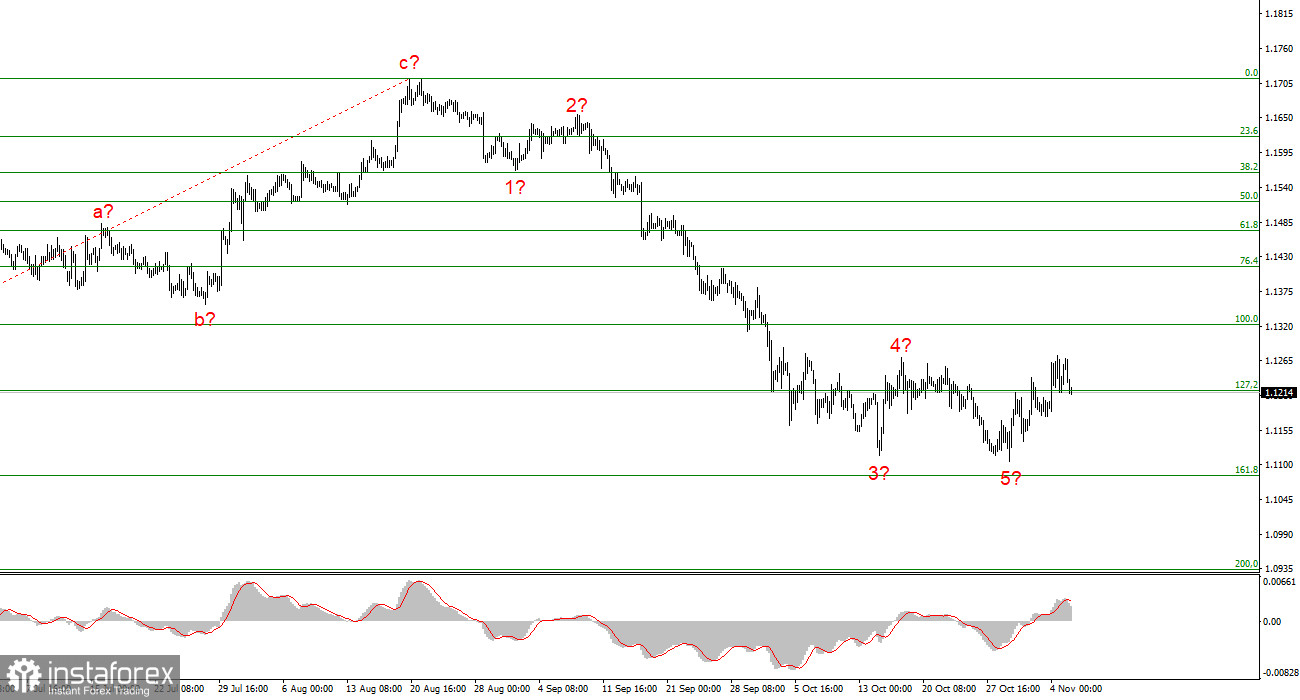
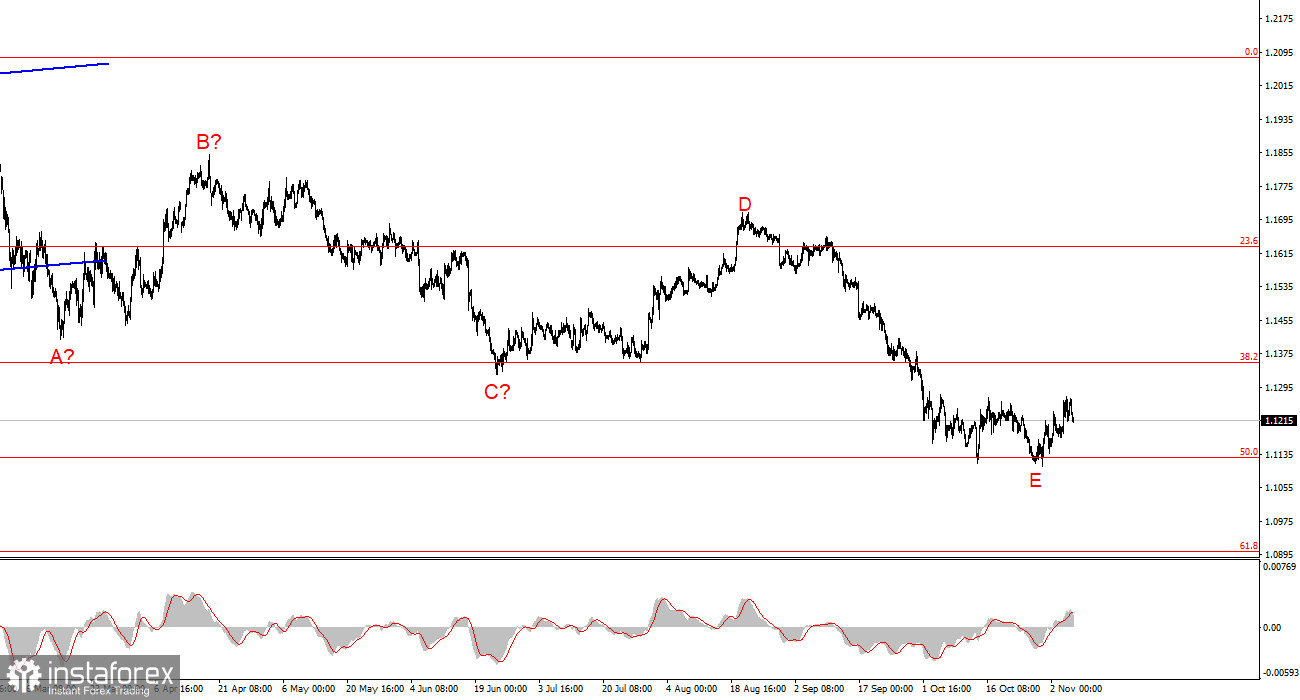
The Elliott Wave structure on the 4-hour chart for EUR/USD has become more complex. On the higher timeframe (bottom chart), the downward trend segment has taken the form of a five-wave structure labeled A-B-C-D-E. This structure could be complete at any moment, as it appears fully developed. All the waves within this segment are approximately equal in size, which is why it is considered corrective. If this assumption is correct, the completion of this structure will be followed by the development of a bullish impulse segment, with targets located well above the 1.2000 level.
On the lower timeframe (top chart), an impulsive wave sequence continues to develop and may belong to wave E of the higher timeframe. If this is indeed the case, the dollar's strengthening is approaching its end, regardless of how strong its advance may be. The presumed wave 5 of E is either complete or nearing completion. In either case, the current wave structure suggests that the downward wave sequence is approaching completion on both timeframes. News developments and a sharp shift in market sentiment have triggered a substantial appreciation of the US dollar, but there are few remaining reasons for further dollar strength.
What Could Support the Euro?
The EUR/USD exchange rate initially rose by 40 points during Thursday's trading session before declining by 50 points, all while the economic calendar was virtually empty. In other words, the market had no clear fundamental reasons to either buy or sell the pair. Of course, in the absence of significant news, exchange rates cannot remain completely unchanged, as trading activity continues regardless. Therefore, today's movements in the euro can be classified as market noise.
However, the situation for the European currency has not improved this week. Despite accelerating inflation in the eurozone, which significantly increases the likelihood of more aggressive ECB rate hikes, and despite Donald Trump's party losing the elections, the euro has still failed to convince traders that buying the currency is justified. At the same time, the market remains concerned about a possible resumption of the war in the Middle East, as well as ongoing unrest and mass protests in France and several other European Union countries. The market still appears to be focusing exclusively on negative developments, which is why the euro remains at such low levels. But what could support the European currency?
As has become clear, the ECB is unlikely to provide significant support for demand for the euro. Could an end to the unrest in the EU help? An official end to the war in the Middle East? A reduction in geopolitical tensions in Europe? These factors could support buyers. However, it is worth noting that positive developments for the euro have also emerged over the past two months. The current Elliott Wave structure suggests that a bullish trend segment is developing on both timeframes. Nevertheless, the euro has failed to produce even a convincing corrective wave, let alone establish an entire upward trend. Therefore, most factors suggest that the period of dollar dominance is approaching its end, but the market remains strongly opposed to this view. Ultimately, exchange rates are driven by the market, not by wave patterns or the news flow.
General Conclusions
Based on the EUR/USD analysis, the pair remains within a global corrective trend segment labeled A-B-C-D-E. However, this structure appears fully developed and may therefore be complete. This may be a favorable time not only to consider buying the European currency but also to anticipate the development of a sustained upward trend. According to the higher timeframe, the pair could be expected to rise to at least the 1.1700–1.1800 level. The failed attempt to break below the 1.1126 level, corresponding to the 50.0% Fibonacci retracement level (bottom chart, higher timeframe), also indicates that the market may be preparing for an upward move.
The higher timeframe shows a downward trend segment that has taken the form of an A-B-C-D-E structure. The internal wave structure of wave E has developed into a five-wave impulse pattern, which may already be complete. If this assumption is correct, a new upward trend segment should now begin to develop.
Key Principles of the Analysis:
- Wave structures should be simple and easy to understand. Complex structures are difficult to trade and often involve changes in the wave count.
- If there is no clear understanding of current market conditions, it is better to stay out of the market.
- There can never be absolute certainty about the direction of market movement. Always use protective Stop Loss orders.
- Elliott Wave analysis can be combined with other forms of market analysis and trading strategies.


