


The euro started the session with a modest recovery but remains under pressure. Friday's US labor market report revived demand for the dollar, while European economic data added to the euro's weakness.
Starting with the United States, nonfarm payrolls increased by 165,000 in October, compared with expectations of 65,000, while the September figure stood at just 60,000. The unemployment rate fell to 4.1% from 4.2%. Monthly wage growth reached 0.4%, while the annual rate came in at 3.1%, against a forecast of 2.9%. Previous months' figures were also revised upward by a combined 84,000. Strong wage growth and a substantial increase in employment indicate that inflation in the United States remains elevated, leaving the Federal Reserve with little reason to ease monetary policy. The market considers a rate hike in December the most likely scenario. It is worth noting that the Fed's interest rate stands at 3.75–4.00%, while the ECB's deposit rate is 2.50%. This interest rate differential supports the dollar.
The situation in Europe is the opposite. Eurozone retail sales fell by 0.7% in September, compared with expectations of a 0.1% decline, following modest growth in the previous month. The annual growth rate slowed to 0.4% from 0.8%. Consumers are spending less because high energy costs and inflation of around 4.0% are putting pressure on household budgets. This remains a problem for the euro: the economy is cooling while prices continue to rise. The ECB is still expected to deliver its final rate hike in December, bringing the rate to 2.75%, but weak economic data are raising doubts about whether it will go any further.
The new week begins without any major market drivers. Germany's September trade balance will be released today. This figure measures the difference between the value of a country's exports and imports. The expected surplus is €18.1 billion, compared with €19.5 billion in the previous month and €21.3 billion in July. If the forecast is confirmed, the trade surplus will have declined for the third consecutive month. For Germany, whose economy relies heavily on exports, this is a worrying signal. High energy costs and weak demand in China and the United Kingdom are weighing on sales. Meanwhile, finance ministers and the Eurogroup will meet in Brussels. The meeting will include discussions about candidates to succeed Lagarde as ECB President when she leaves office on February 7, although no decision is usually made at this stage. The final choice is expected at the leaders' summit on November 26–27. For the exchange rate, this is more of a background factor than a potential market catalyst.
What to expect from the euro. As long as US economic data outperform European figures, a sustained recovery will be difficult. Any upward movement is more likely to represent a short-term correction. Only unexpectedly strong German data or hawkish comments from ECB representatives could support the euro, but there are no such signals at present.
Momentum
This strategy focuses on the continuation of a price movement following a breakout. A breakout occurs when the price moves beyond a certain level and consolidates there, meaning that it holds above or below that level rather than moving back across it. The price is currently trading within a range between two key levels: the upper boundary at 1.1177 is 16 points away, while the lower boundary at 1.1138 is 23 points away. As long as the price remains within this range, there is no clear direction, so beginners are better off waiting rather than trying to anticipate the next move.
The 1.1177 level is important for an upward move. If the euro rises confidently above this level and consolidates there, it will signal that buyers have gained the upper hand. This would open the way toward 1.1211 and then 1.1244. The first target is relatively close, while the second is considerably further away, and the price may pause or retrace halfway. This scenario would require a catalyst, such as weak US economic data or unexpectedly strong European figures. There are no such factors at present, so an upward move is considered less likely. It would be more consistent with a rebound following a prolonged decline than with a trend reversal.
For a downward move, attention is focused on 1.1138. If the price breaks below this level and consolidates beneath it, this will signal that sellers remain in control. The next targets are 1.1108 and 1.1082. This is considered the primary scenario. It is supported by the strong US employment report, weak eurozone retail sales, and the interest rate differential. The only factor working against it is the possibility of a pause following the prolonged decline, as the pair has already rebounded overnight from lows near 1.1136.
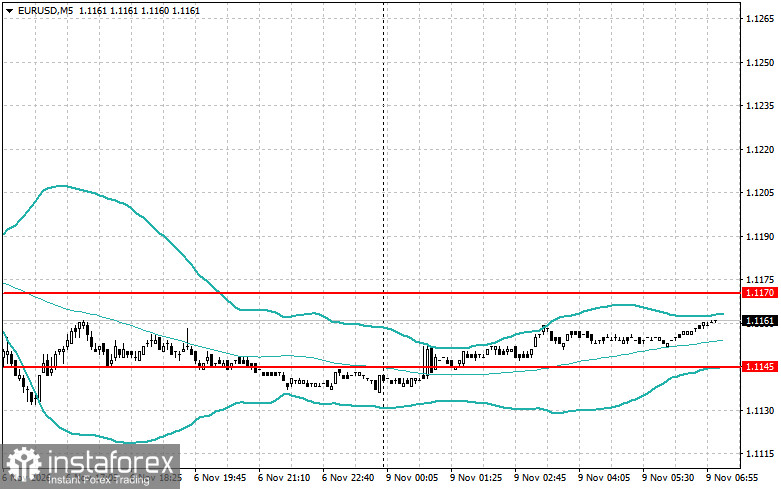
Mean Reversion
This strategy is based on the opposite idea. Sometimes the price moves beyond a level but fails to hold there and quickly returns. This is known as a reversal back through the level, and it differs from a breakout because the price does not consolidate beyond it. It is impossible to distinguish between the two based on the first test alone, so beginners should avoid rushing into a trade. Instead, they should wait for the price to move beyond the level first and then return back across it.
The upper reference level is 1.1170, while the lower one is 1.1145. The upper level is just 9 points above the current price, making it very close. If the price reaches 1.1170, loses momentum, and turns downward, this would indicate a failed move above the level and support the primary bearish scenario. The lower level at 1.1145 is 7 points above the breakout level of 1.1138. If the price falls to 1.1145 and quickly moves back above it, this would also indicate a failed move below the level. However, if 1.1145 is broken without a subsequent recovery, the next level to watch will be 1.1138, where the Momentum scenario comes into play. Therefore, the initial reaction at either level may prove to be false, and it is better to wait and see how the price develops.


