


Trade Review and Tips for Trading the Japanese Yen
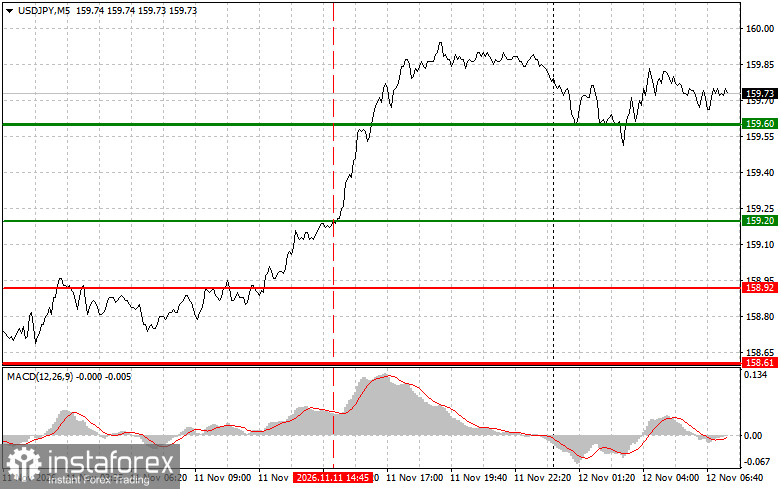
The price test at 159.20 occurred after the MACD indicator had already moved well above the zero line, limiting the pair's upside potential. For that reason, I did not buy the dollar and missed a good move higher.
Over two days, the pair moved roughly from 158 to nearly 160. The trigger was US data: US inflation exceeded forecasts for the third month in a row, and hawkish comments from Federal Reserve officials raised expectations that rates will be raised again in December. Traders also began pricing in a small chance of a 50-bp step. The rate gap between the US and Japan is widening again, and the yen has already lost some of the safe-haven demand that appeared during recent equity-market turbulence.
At the same time, Japanese data support expectations of a Bank of Japan hike. Producer prices rose 7.1% y/y in October, up from 6.8% a month earlier and above forecasts of a slowdown; month-on-month, they rose 0.7%, the fastest since May. Swap markets now price about an 82% chance of a BOJ hike at the December 18 meeting. Price rises were led by oil and related products—in October, oil traded above $100/bbl, and many companies revised prices that month. For a country heavily dependent on imports of oil, raw materials and food, a weak yen only adds to cost-of-living pressure. Recall that Kazuo Ueda has left the door open for further hikes, but timing beyond December remains uncertain as the policy rate approaches neutral.
Recent media reports say Japanese authorities are increasingly concerned about the speed and disorderly nature of the yen's move. Many traders expect warnings about the yen to grow louder, but threats alone are unlikely to be enough. The dollar remains very strong on Fed expectations, and even if the BOJ accelerates hikes, it will be hard to outpace the US regulator. Without actual intervention, verbal action may only produce a brief pause, and USD/JPY remains at risk of breaking above 160.
For intraday strategy, I will mainly rely on scenarios No. 1 and No. 2.
Scenarios to Buy
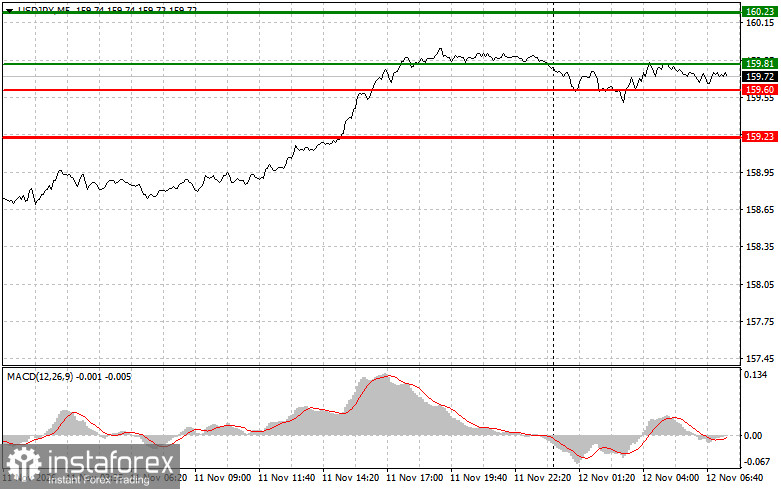
Scenario No. 1: I plan to buy USD/JPY today when the entry point around 159.81 (green line on the chart) is reached, with a target of rising to 160.23 (thicker green line on the chart). Around 160.23, I will exit long positions and open short positions in the opposite direction (expecting a 30–35 pip move away from the level). It is best to return to buying the pair on corrections and significant pullbacks. Important! Before buying, make sure the MACD indicator is above the zero line and is just beginning to rise from it.
Scenario No. 2: I also plan to buy USD/JPY today in the event of two consecutive tests of 159.60 while the MACD indicator is in the oversold area. This will limit the pair's downside potential and lead to an upward reversal. You can expect a rise to the opposite levels of 159.81 and 160.23.
Scenarios to Sell
Scenario No. 1: I plan to sell USD/JPY today only after the 159.60 level is breached (red line on the chart), which will lead to a rapid decline of the pair. The key target for sellers is 159.23, where I will exit shorts and immediately open longs in the opposite direction (expecting a 20–25 pip move away from the level). Sellers can return at any moment — only a hint from the central bank is needed. Important! Before selling, make sure the MACD indicator is below the zero line and is just beginning to fall from it.
Scenario No. 2: I also plan to sell USD/JPY today in the event of two consecutive tests of 159.81 while the MACD indicator is in the overbought area. This will limit the pair's upside potential and lead to a downward reversal. You can expect a decline to the opposite levels of 159.60 and 159.23.
What's on the Chart:
Thin green line – the entry price at which you can buy the trading instrument;
Thick green line – the suggested price where you can place a Take Profit or manually lock in gains, since further upside above this level is unlikely;
Thin red line – the entry price at which you can sell the trading instrument;
Thick red line – the suggested price where you can place a Take Profit or manually lock in gains, since further downside below this level is unlikely;
MACD indicator. When entering the market, it is important to follow the overbought and oversold zones.
Important. Beginner Forex traders must be very cautious when making entry decisions. Before the release of important fundamental reports, it is best to stay out of the market to avoid getting caught in sharp price swings. If you decide to trade during news releases, always place stop orders to minimize losses. Without stop orders, you can quickly lose your entire deposit, especially if you don't use money management and trade large volumes.
Remember, successful trading requires a clear trading plan, like the example I presented above. Spontaneous trading decisions based on the current market situation are a losing strategy for an intraday trader from the start.


