


The backdrop for EUR/USD is shaped not only by the numbers but also by rate expectations. Futures price in 25 bps hikes by the Federal Reserve in December, January, and March. One basis point is one one-hundredth of a percent, so 25 bps equals 0.25%. Mary Daly said last week that further tightening will be needed, although she previously thought policy was in a good place. In September, John Williams said there was no need to rush after the first hike, but now calls inflation too high, even by the latest data. Friday's data did not change this picture. The producer price index — that is, the prices at which firms sell their goods — rose by 0.3% month-on-month versus a 0.4% forecast after 1.4% in September. However, the annual rate accelerated to 6.5% from 6.3% a month earlier, the highest level since November 2022. The core measure, excluding fuel and food, was 0.3% as expected after 0.8% in September.
The situation at the European Central Bank is different. The deposit rate remains at 2.50%; a rise to 2.75% is expected on December 17, and many consider it the last one. By preliminary estimate, inflation in October accelerated to 4.0% from 3.8%, but the economy is losing momentum. Eurozone GDP — the total volume of what it produces — grew by 0.4% in Q3 after 0.6% in Q2; for the EU it was 0.5% after 0.7%. Employment was unchanged, while in Q2 it increased by 0.1%. Annual growth was 1.3% versus 1.2% earlier. The US grew by 0.8% over the same period, up from 0.6%, i.e., twice as fast as the eurozone. I believe that as long as the Fed is confidently moving toward further hikes while eurozone growth weakens, pressure on the euro will remain.
Today's main event for the euro will be eurozone industrial production data for September, but it shouldn't provide strong support. The previous release looked weak. In August, output fell by 0.5% month-on-month versus a 0.0% forecast after -0.3% in July, and it declined 1.1% year-on-year. The region's industry is increasingly suffering from expensive energy and weak demand, and one publication is unlikely to change that picture. Recent dynamics don't add optimism either. From November 10 to 12, the pair lost more than 140 pips, falling from 1.1229 to 1.1083; on Friday afternoon it stood around 1.1056 and is now trading near 1.1024. While the euro has no strong drivers, it is wiser to trade with the trend rather than try to guess a reversal.
Momentum
Now EURUSD stands at 1.1024, inside the range between 1.1004 and 1.1036. A move beyond the border is a breakout, but one touch is not enough—consolidation is needed, meaning several consecutive five-minute candles must close beyond the level. Otherwise, it is easy to get caught on a false breakout, after which the price will return.
From above 1.1036 is active. Consolidation above it opens the way to 1.1069 and then to 1.1102. Since Friday evening, the price rose only to 1.1035, nearly reaching but failing to break, and this is a proven ceiling. The first target, 1.1069, lies close to Friday's high around 1.1062, so selling often occur there. Eurozone industry after the August slump is unlikely to give the market a reason for such a surge, and I have little faith in that scenario.
Below the reference is 1.1004; consolidation below it leads to 1.0973, then to 1.0939. I consider this direction primary. The Fed is confidently moving toward hikes, eurozone growth slowed from 0.6% to 0.4%, and the US economy is growing twice as fast. The first thing to pass will be the nearby low around 1.1013, a move of about twenty pips. If the price does that and consolidates, the drop could be quick. I would not enter on the first touch.
Mean Reversion
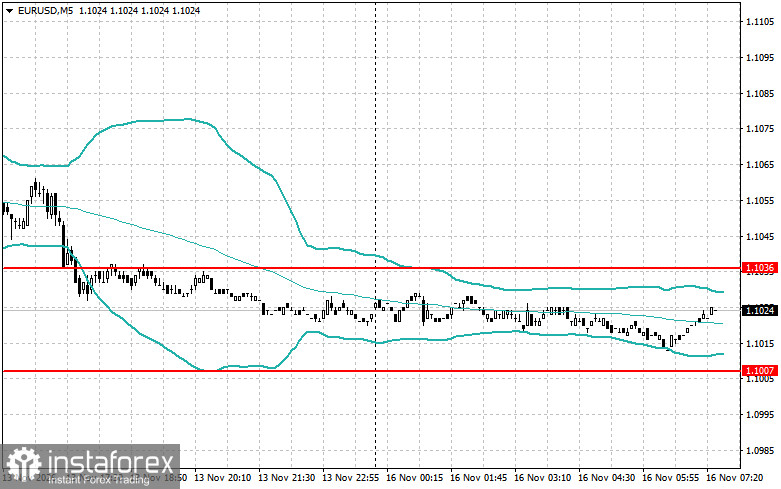
There are two levels here: 1.1036 and 1.1007. The upper reference 1.1036 coincides with the breakout point for buying at 1.1036, so special caution is required. The same price serves as both a signal for a rise and a mark for a return down, and on the first touch it is impossible to determine which scenario has been triggered. If the price consolidates above 1.1036, the upward breakout is working, and you must not sell there. If, however, it reaches 1.1036, finds no continuation, and quickly returns below, I consider selling toward 1.1007 with a stop above 1.1042, with a small margin. This picture is most likely if industrial data comes close to expectations and the market retraces after the initial reaction. The difference between the two scenarios may take several minutes, so it is better to skip the first reaction in the zone.
The lower reference 1.1007 lies three pips above the breakout point for selling at 1.1004 and six pips below the low around 1.1013, so the price first needs to refresh that low. It is easiest to err here, because the gap from a continuation of the fall to a false breakout is only three pips. The scheme is this. The price falls to 1.1007, cannot consolidate below, and returns above, and then I look to buy toward 1.1036 with a stop below 1.1004 with a small margin. Such a rebound is most likely if the Fed doesn't drop any new tough words and the market starts taking profit after last week's decline. If the price confidently consolidates below 1.1004, the return is canceled and the downward breakout works.


