


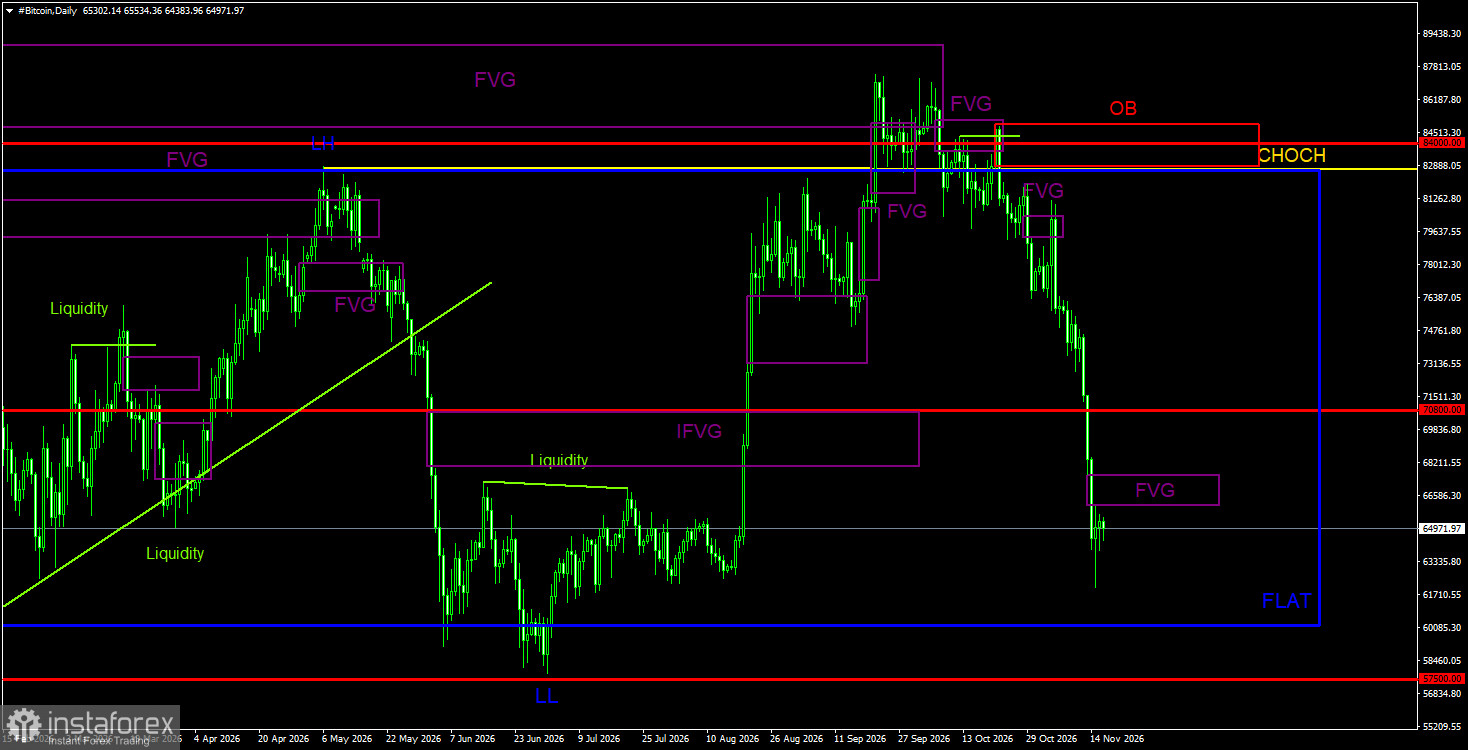
Bitcoin and Ether continue their downward move, repeatedly fed by fresh negative headlines. Recall that recent events for the crypto world have been uniformly negative. Central banks—notably the Fed—continue to tighten monetary policy; the Clarity Act remains only a bill; and Democrats won the U.S. congressional elections, further reducing the odds that the Clarity Act becomes law. Historically Bitcoin tends to fall after midterms (which we are observing now), and two weeks ago the list of headwinds grew with the hack of the world's largest crypto exchange, Binance. That was followed by a U.S. stock market sell-off and a rout in technology shares, which many experts closely link to Bitcoin's price. Then U.S. inflation accelerated more than forecasts, further raising the market's hawkish expectations for Fed policy. The cherry on top was Nvidia CEO Jensen Huang's resignation, which triggered a mass capital outflow from tech stocks. The stock market pulled the crypto market down again. Thus the fundamental case for Bitcoin's rise remains, to put it mildly, doubtful.
Meanwhile, well-known strategist Mike McGlone—who, unlike many other "experts," does not forecast perpetual gains for "digital gold" or urge buying it—said Bitcoin could fall below $60,000 and even below $50,000. McGlone believes Bitcoin's decline over the past six weeks is the market's answer to the question of how it currently views risk. The strategist noted that U.S. bond yields are near 25-year highs, which significantly reduces the appeal of gold and digital assets for investors. He also observed that reaching $60,000 does not necessarily mean formation of a "triple bottom" pattern followed by a long-term bull trend. McGlone expects equities to continue to fall and that the Nasdaq and S&P 500 could drag Bitcoin far below $50,000. It is worth noting that the $57,500–$60,200 area is indeed crucial for Bitcoin. If that zone is breached, Bitcoin could head as low as $10,000. Below that area, even most long-term holders would be underwater. Thus, the lower Bitcoin falls, the stronger a new cascade of selling and liquidations may be. And Bitcoin has no "absolute floor" beneath which it simply cannot fall.
Trading recommendations for BTC/USD:
Bitcoin attempted to start a new uptrend, but the fundamental backdrop, spot demand, and recent news are too negative to rely on continuation. In the near term on the daily timeframe, Bitcoin may remain in decline, since price formed a deviation of the flat's upper boundary and reacted to three bearish FVGs. Short positions remain the most relevant in the near term with targets at $60,200 and $57,500. The new bearish FVG on the daily chart may provide traders another opportunity to enter the market with short positions.
Trading recommendations for ETH/USD:
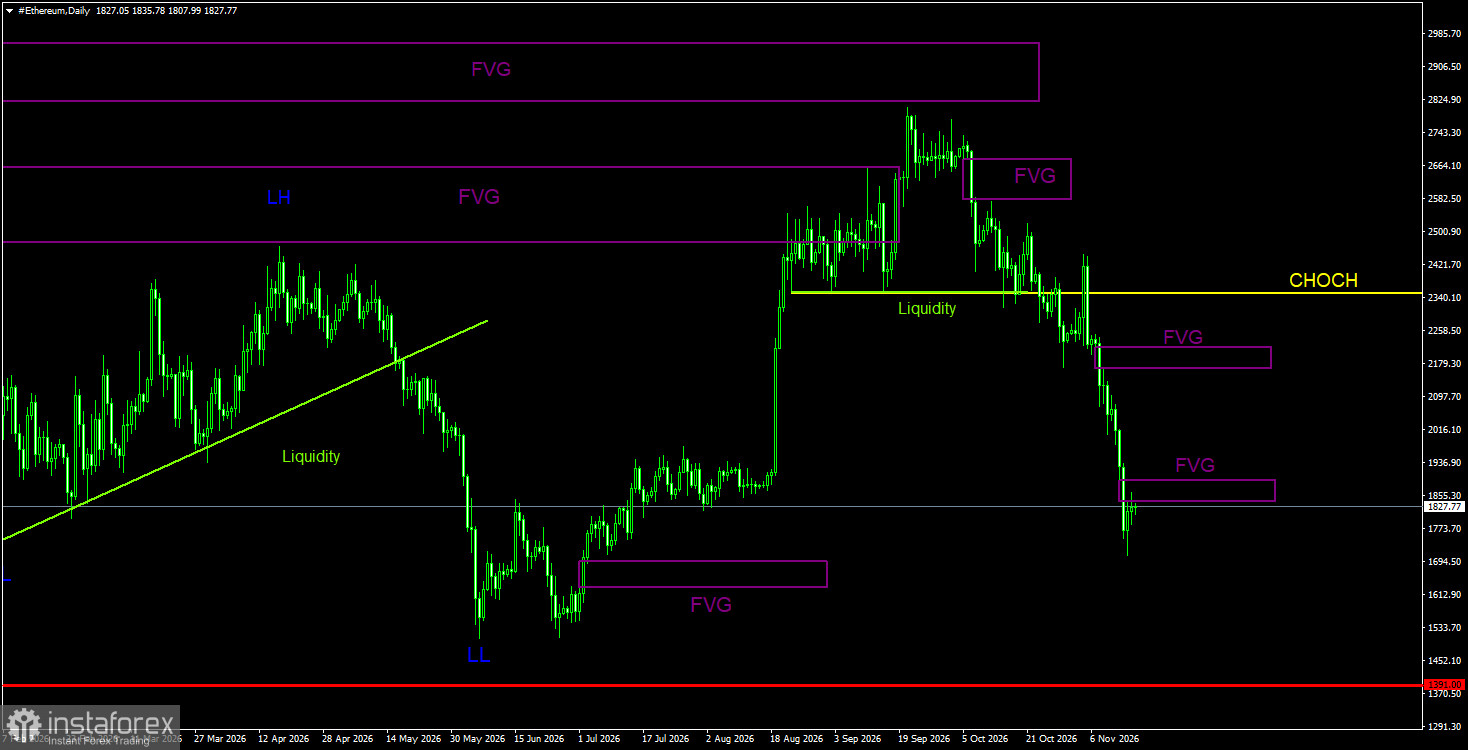
The daily technical picture for Ether has changed. Ether made a significant upward impulse in June–September 2026 that could mark the start of a new long-term trend. However, at the same time, there is no confidence that Bitcoin's bear market has ended. Bitcoin has produced enough sell signals and bearish patterns on the daily chart to explain the declines of recent weeks. Therefore, it is unsurprising Ether also plunged and may continue south. The target is near $1,391. On the daily and 4-hour timeframes there are multiple bearish FVGs that act as POIs for short positions. Expect Ether's slide to end only if Bitcoin fails to breach the lower boundary of the daily sideways channel.
Illustration notes:
CHOCH—change of trend structure.
Liquidity—liquidity, stop losses, and pending orders that market makers use to build positions.
FVG—fair value gap. A price inefficiency area that price traverses quickly, indicating the absence of one side of the market; thereafter price tends to return and react to such areas in continuation of the main trend.
IFVG — inverted fair value gap. After returning to such an area, the price often does not react but impulsively breaks through and then tests from the other side.
OB — order block. The candle where a market maker opened a position aiming to take liquidity to form a position in the opposite direction.


