


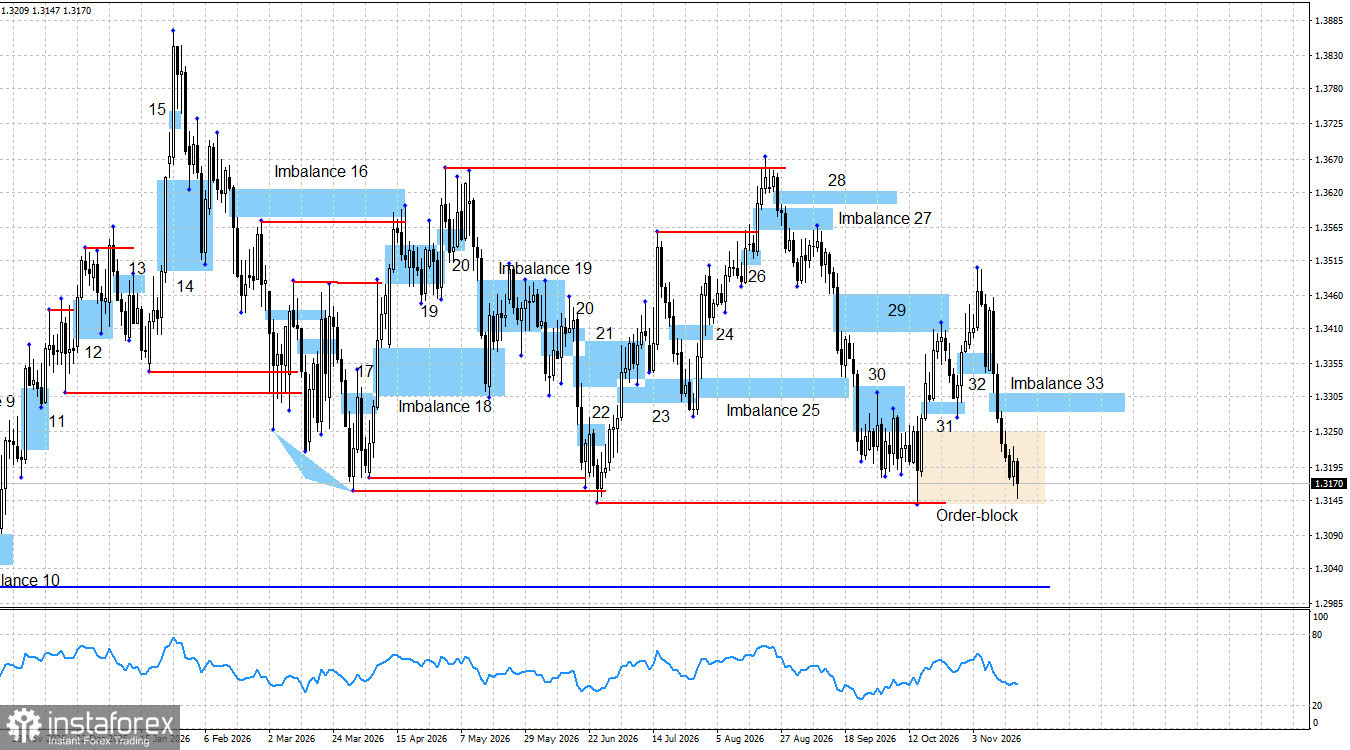
GBP/USD has already plunged by 340 points. The initial trigger for the decline was US economic data. An increase in inflation of 0.4% month over month in October was enough to send the US dollar sharply higher. The dollar has now been rising for seven consecutive days, even though some individual days brought no positive news for the US currency. Yesterday, the UK unemployment rate could have triggered a bullish move, had the bulls shown any willingness to launch an attack. Today, the UK inflation report was released, and traders welcomed it much more enthusiastically than the unemployment data, as it provided another opportunity to sell the pound.
In my view, the market is generating a move largely on its own, without sufficient fundamental justification. In other words, the US dollar is rising not only because of strong inflation, a resilient labor market, and low unemployment in the United States. It is also rising because the market is eager to buy it. At present, GBP/USD has retraced to an order block, which is a relatively rare and powerful pattern. A market reaction to this pattern and a recovery in the correlation between the euro and the pound are expected. However, if this pattern is invalidated, the bulls will have no further support. Given the way traders interpret economic data, it would not be surprising if the order block were invalidated by the end of the week.
The Bank of England implemented its first monetary policy tightening in early November. Traders' reaction to this decision was rather mixed. The bulls did not continue their advance, even though the outcome of the Bank of England meeting could be considered as hawkish as possible. The Bank of England's policymakers not only raised interest rates, as expected, but also made the decision unanimously. However, traders placed greater importance on the US inflation and labor market reports, which also increased the likelihood of further monetary tightening. For the market, a Fed rate hike is currently one thing, while a Bank of England rate hike is quite another.
Another important factor for the pound's outlook is that traders expect the Bank of England to implement at least three additional rate hikes in total, while the Fed is expected to deliver only one or, at most, two. Of course, it is impossible to know how events will unfold in 2027, but this is the current consensus forecast. Thus, the Bank of England could ultimately raise interest rates even more than the Fed, which is clearly not a factor that should support the US dollar. Geopolitical developments could provide support for the dollar in the near term if Donald Trump decides to resume military action against Iran. However, recent developments around the Strait of Hormuz suggest that neither Iran nor the United States is particularly interested in restarting the conflict.
Do bears have further potential? In my view, it is limited. The bears have pushed the dollar to the upper end of its trading range, but they have still failed to break out of it. There have been several compelling reasons to buy the US dollar in 2026, but there have also been reasons for the British pound to appreciate, which traders have often overlooked. Thus, unlike the euro, the dollar and the pound have generally followed a fairly logical pattern in 2026, alternating between periods of gains and losses that have ultimately kept the pair within a trading range.
The economic news flow on Wednesday was not particularly favorable for the bulls. The UK Consumer Price Index rose less than expected, while core inflation remained unchanged. As a result, traders initially reacted rather weakly to the strong unemployment report but then responded much more enthusiastically to the disappointing inflation data.
The overall fundamental backdrop remains such that, in the long term, a decline in the US dollar is the only outcome that can reasonably be expected. The conflict between Iran and the United States has not changed this outlook. Geopolitical developments have reminded the market of the dollar's safe-haven status, but the conflict is currently on hold and may even be heading toward a resolution. Therefore, until hostilities resume, a new bearish advance is not expected. Escalation remains possible, as Donald Trump is certainly capable of making an unpredictable decision. If the next round of negotiations ends in the same way as all previous attempts, Trump may decide to launch further strikes. Even the Democrats may be unable to prevent him from doing so.
Economic Calendar for the United States and the United Kingdom:
- United States – Initial Jobless Claims (13:30 UTC).
- United States – Philadelphia Fed Manufacturing Index (13:30 UTC).
On November 19, the economic calendar contains only two releases, neither of which is considered particularly important. The impact of economic data on market sentiment on Thursday may therefore be limited.
GBP/USD Forecast and Trading Recommendations:
The long-term outlook for the pound remains bullish. Bears controlled the market over the past week, but only within the trading range, which is clearly visible on the daily chart and remains intact. The pound's targets are still located near the upper boundary of the range at 1.3670, but traders now need fresh bullish signals. The only potential source of such signals is a reaction to the order block. An order block is a strong and relatively rare pattern, so the probability of a rebound from it is considered high. The bulls may also attempt to sweep liquidity below the previous low. It is worth recalling that, within the 2026 trading range, most reversals occurred precisely after liquidity sweeps. The bears, meanwhile, have a new imbalance at 1.33, which, if the order block is invalidated, could provide opportunities to open short positions targeting levels below 1.3130.


