


The pound remains under pressure, and yesterday's weak U.S. data did not help. In the evening, GBP/USD lost about 55 pips, sliding from 1.3162 to 1.3105, then dipped further overnight to roughly 1.3078, and only later recovered about 27 pips. Now the pair stands near 1.3105. Yesterday daytime, the pound was around 1.3150, and on November 10 it was about 1.3449 — a loss of roughly 340 pips since then. Logic would suggest the dollar should weaken after poor U.S. data, but demand for it has remained very strong.
Start with the UK backdrop. The Bank of England received no new argument for a second hike. The policy rate is 4.00%, and the market sees December odds at about 50/50. Swati Dhingra, who spoke yesterday, voted to pause in September and for a hike on November 5; she remains cautious. UK inflation in October accelerated to 3.6% from 3.5%, but that was already priced in, so it gave no extra strength to the pound.
Now what happened in the U.S. The Philly Fed manufacturing index — a survey of factories around Philadelphia — plunged to 6.3 versus a 20.6 forecast (it was 37.8 in September). Initial jobless claims came in at 203k versus a 198k forecast, noticeably higher than the 189k reading on November 5, a multi-decade low. All this signals cooling. But the dollar was helped by the Treasury Inflation-Protected Securities (TIPS) auction: the tail real yield was 2.903% versus 2.653% at the previous auction. Higher real yields make dollar assets more attractive.
The key driver remains Federal Reserve tone. Mary Daly, president of the San Francisco Fed, said on November 10 that gradual further tightening is appropriate; yesterday she added that a pause works best when the policy path is clear, and she noted she supported the October pause. A 25-bp hike on December 9 is already fully priced, and as long as officials' rhetoric remains hawkish, I expect GBP/USD to be driven more by the dollar than by UK news.
Today the pound faces UK retail sales for October. They show household spending in stores — the backbone of the economy. The headline is forecast at 0.0% month-on-month after a -0.4% drop in September; ex-fuel sales are expected -0.1% after -0.7%. Year-on-year, ex-fuel sales are forecast to rise to 1.7% from 0.8%. In September sales fell despite a small expected decline, and the pound reacted poorly even to otherwise normal reads. The backdrop for buyers is cautious. GfK consumer confidence fell to -24 in October (forecast -14, prior -13), and Rightmove asking prices dropped 1.8% month-on-month in November. If retail sales fall for a second month, the market may doubt whether the economy can withstand a 4.00% rate. A zero print or small gain, in my view, would only provide a brief respite for the pair.
Momentum
Now GBPUSD stands at 1.3105, inside a range between 1.3084 and 1.3128. It is about 21 pips to the lower boundary and about 23 pips to the upper. A breakout means a move beyond the boundary with consolidation — several consecutive five-minute candles closing beyond the level — because a single touch proves nothing.
From above 1.3128 is active. Consolidation above it opens the way to 1.3168 and then to 1.3209. Interestingly, this ceiling is almost where yesterday's sell point at 1.3122 was, and the pair slipped below it. The first target, 1.3168, lies near recent highs around 1.3168, and the second, 1.3209, is near the November 18 overnight high around 1.3206, so sellers are likely to appear in both zones. A rally would need either strong UK data or sudden dollar weakness—and yesterday showed that even poor US numbers don't faze the dollar. I have little faith in an upside burst.
From below, the reference is 1.3084; consolidation below it leads to 1.3038 and then 1.3013. I treat this direction as primary. Yesterday, 1.3084 was the first downside target. Overnight price spent several hours around that level, once dipping to about 1.3078 (six pips below) before bouncing. For comparison: on November 10 the pair was around 1.3449, yesterday daytime about 1.3150, and now 1.3105 — each day finding a new low below the previous one. It is about 21 pips to the level. If retail sales disappoint and US officials repeat hawkish rhetoric, a close below would produce a rapid decline. I would not enter on the first touch.
Mean Reversion
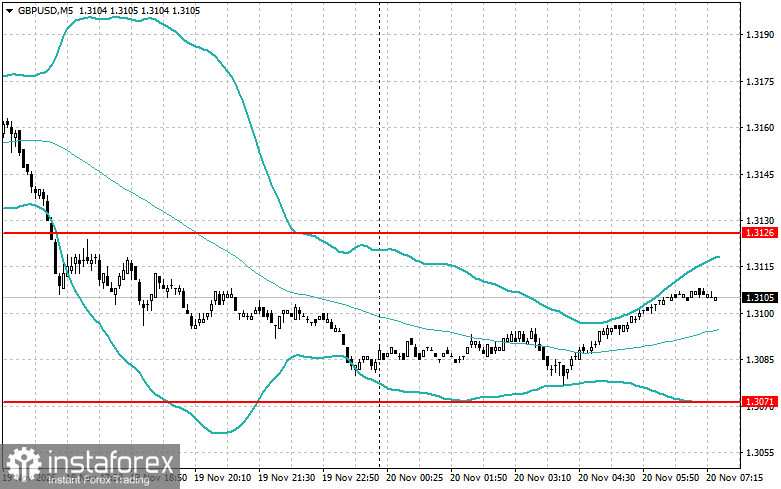
There are two levels here: 1.3126 and 1.3071. The upper reference 1.3126 sits just two pips below the upside breakout point at 1.3128, so extreme caution is required. These marks are almost merged, and on the first touch you cannot tell which scenario is active. If price consolidates above 1.3128, the upside breakout is working, and you must not sell. If it reaches 1.3126, finds no continuation, and quickly returns below, I consider selling toward 1.3071 with a stop above 1.3134 — i.e., above the breakout point with a small margin. That picture is likely if retail sales print close to forecast and the market retraces after the initial reaction. The difference between the two scenarios may take several minutes to materialize, so it is better to skip the first reaction in the zone.
The lower reference 1.3071 lies 13 pips below the downside breakout point 1.3084 and 34 pips below the current price, so the breakout level must be passed first. The overnight low around 1.3078 missed it by seven pips. The scheme is this: price closes below 1.3084, falls to 1.3071, cannot hold below, and returns higher; then I look to buy toward 1.3126 with a stop below 1.3065. A buffer is essential because price often slips a few pips beyond the level. A rebound is likely if no new hawkish Fed comments appear and the market starts taking profits at week-end. If price confidently consolidates below 1.3071, the return is canceled and the downward breakout to 1.3038 works.


