


Analysis of trades and trading tips for the Japanese yen
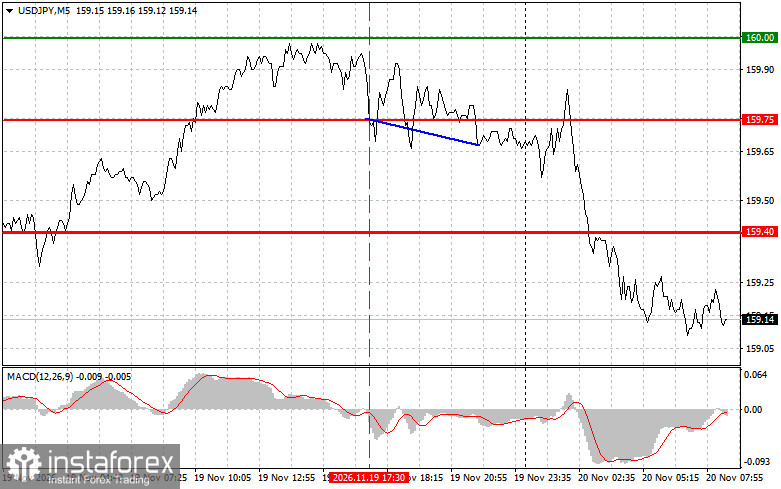
The 159.75 price test occurred as the MACD indicator had just begun moving down from the zero line, confirming a valid entry point to sell the dollar. However, the pair did not follow through with a large decline.
Today the yen strengthened after Japanese inflation data, and the chances of a more aggressive Bank of Japan rate hike increased. Core CPI excluding fresh food rose 2.2% year-on-year in October — the largest increase since December. Energy prices made the main contribution, rising 2.2%, and mobile-phone charges accelerated to 17.2%. Such figures strengthen the case for a hike from 1.25% at the December 18 meeting, and swap markets price the probability of that move at roughly 86%.
U.S. data printed weak yesterday, but it didn't help the dollar fall. The Philly Fed index came in at 6.3 versus a 20.6 forecast (after 20.9), initial jobless claims were 203k versus an expected 198k, and leading indicators were -0.3%. Mary Daly of the San Francisco Federal Reserve (or Patrick Harker/Philly Fed speaker as noted earlier) yesterday emphasized the importance of clear communication. It reminded markets she supported the October pause.
Although dollar demand remains strong, I believe confirmed Japanese inflation and the growing case for BOJ tightening will support the yen, and any dollar strength is likely to be corrective.
For intraday strategy, I will rely mainly on Scenarios No. 1 and No. 2.
Buy Scenarios
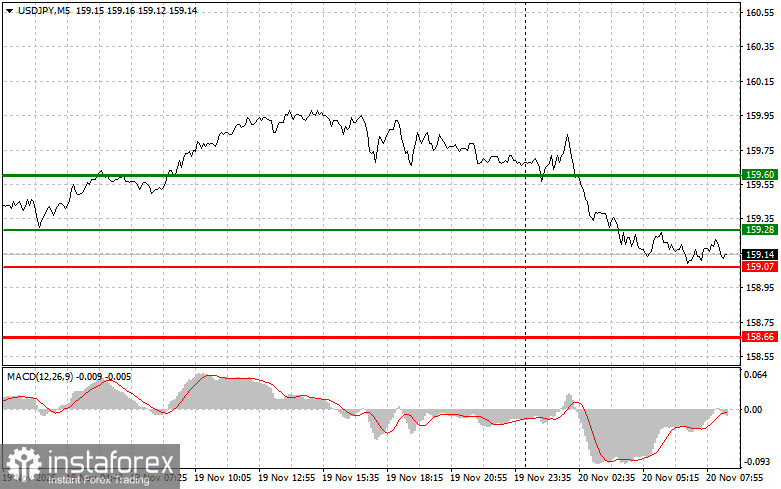
Scenario No. 1: Today I plan to buy USD/JPY when the entry point reaches around 159.28 (the green line on the chart), targeting 159.60 (the thicker green line on the chart). Around 159.60, I plan to exit long positions and open short positions in the opposite direction (expecting a 30–35 pip move back from that level). It is best to return to buying the pair on corrections and significant pullbacks. Important: before buying, make sure the MACD indicator is above zero and is just beginning to rise from it.
Scenario No. 2: I also plan to buy USD/JPY today in case of two consecutive tests of 159.07 when the MACD indicator is in the oversold area. This will limit the pair's downside potential and lead to an upward reversal. You can expect a rise to the opposite levels 159.28 and 159.60.
Sell Scenarios
Scenario No. 1: Today I plan to sell USD/JPY only after the 159.07 level is breached (the red line on the chart), which will lead to a rapid decline in the pair. The sellers' key target will be 158.66, where I intend to exit shorts and immediately open longs in the opposite direction (expecting a 20–25 pip move back from that level). Sellers can return at any moment; only the slightest hint from the central bank is needed. Important: before selling, make sure the MACD indicator is below zero and is just beginning to decline from it.
Scenario No. 2: I also plan to sell USD/JPY today in case of two consecutive tests of 159.28 when the MACD indicator is in the overbought area. This will limit the pair's upside potential and lead to a downward reversal. You can expect a decline to the opposite levels of 159.07 and 158.66.
What's on the Chart:
Thin green line – the entry price at which you can buy the trading instrument;
Thick green line – the suggested price where you can place a Take Profit or manually lock in gains, since further upside above this level is unlikely;
Thin red line – the entry price at which you can sell the trading instrument;
Thick red line – the suggested price where you can place a Take Profit or manually lock in gains, since further downside below this level is unlikely;
MACD indicator. When entering the market, it is important to follow the overbought and oversold zones.
Important. Beginner Forex traders must be very cautious when making entry decisions. Before the release of important fundamental reports, it is best to stay out of the market to avoid getting caught in sharp price swings. If you decide to trade during news releases, always place stop orders to minimize losses. Without stop orders, you can quickly lose your entire deposit, especially if you don't use money management and trade large volumes.
Remember, successful trading requires a clear trading plan, like the example I presented above. Spontaneous trading decisions based on the current market situation are a losing strategy for an intraday trader from the start.


