


For now, Bitcoin is trading around $61,900, roughly 18% below Strategy's average purchase price of $75,452. At an investor session on November 19, company management explained what they are — and aren't — worried about.

Saylor's main message was that a prolonged bear market won't kill the business because dollar reserves will last more than three years. They currently amount to about $4.9 billion, and Saylor estimated coverage of payouts at roughly 3.4 years. It's notable how quickly the picture changed. In December 2025 a reserve of $1.44 billion covered dividends for 21 months; today $4.9 billion covers interest on convertible bonds and dividends on preferred shares for 3.4 years. When Bitcoin last stood near $61,400, coverage was only about 0.7 years. Saylor himself said the company could operate for about three years without selling securities, but that is not a guarantee against future losses. The reserve is primarily needed to pay holders of the preferred STRC, and these fixed payments remain the main pressure on the balance sheet.
The only scenario Saylor named that would threaten the business model itself is an instantaneous, irreversible collapse of Bitcoin to zero, not a prolonged decline. The logic is clear — he has previously said the company has no purchase-price–linked conditions or triggers, so it won't be forced to sell coins below cost. But an important detail was lost in the retelling. Below a certain threshold, Saylor said, the company "might even sell Bitcoin to buy STRC," and as an example he cited selling MSTR shares at 0.98 of net asset value in order to buy STRC at $95. Strategy has already repurchased roughly $3 billion of STRC at $95–$99 from an initial issuance at $100, and the total issuance of about $7.7 billion could shrink to $5 billion, since Saylor estimates natural demand for the paper at the 12% rate to be $5–7.5 billion.
Management then spoke about the future. Saylor aims to turn Strategy into a $1 trillion company through digital credit instruments, although market capitalization was about $52 billion as of November 10.
All of this suggests we should not expect forced Bitcoin sales by Strategy in the coming years, and I consider that scenario unlikely while the reserve covers more than three years of payouts. However, the company is not acting as the buyer that supported the market in past cycles. Therefore, I do not expect Strategy to prop up the price and still allow for a test of $60,000 with a move toward the June low around $58,500; a true reversal will depend not on Saylor's reserves but on the turn in real interest rates.
Technical analysis and recommendations
Bitcoin
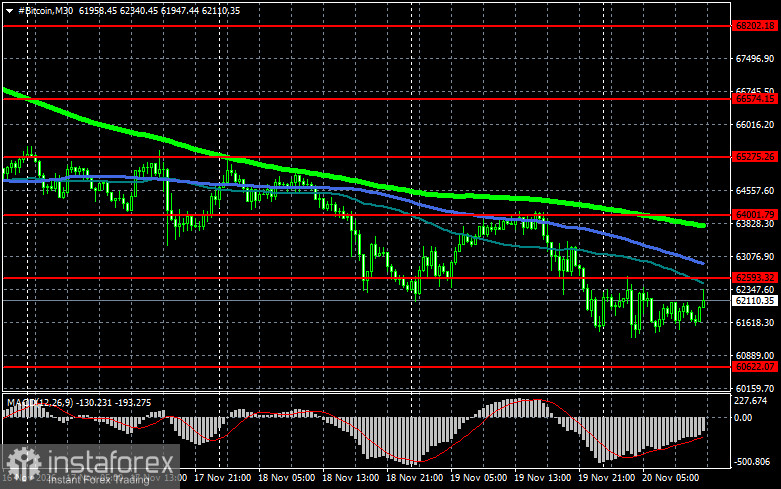
Buyers are currently targeting a return to $62,600, which would open a direct path to $64,000, and from there $66,500 is within reach — breaking that level would signal attempts to restore a bull market. In case of a drop, I expect buyers at $60,600. A return of the instrument below that area could quickly send BTC toward $58,500. The furthest target would be around $56,100.
Ethereum
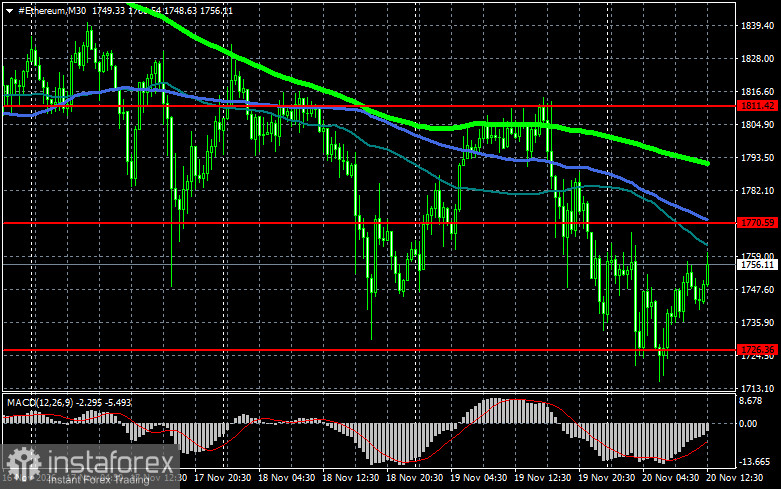
A clear hold above $1,770 would open a direct path to $1,811. The furthest target would be the high near $1,858; breaking that would indicate strengthening bullish sentiment and renewed buyer interest. In case of a drop, I expect buyers at $1,726. A return below that area could quickly push ETH toward $1,650. The furthest target would be around $1,573.
Comments on the chart
- The red lines represent support and resistance levels, where the price is expected to either pause or react sharply.
- The green line shows the 50-day moving average.
- The blue line is the 100-day moving average.
- The lime line is the 200-day moving average.
Price testing or crossing any of these moving averages often either halts movement or injects fresh momentum into the market.


