


















Trade Analysis and Tips for Trading the Japanese Yen
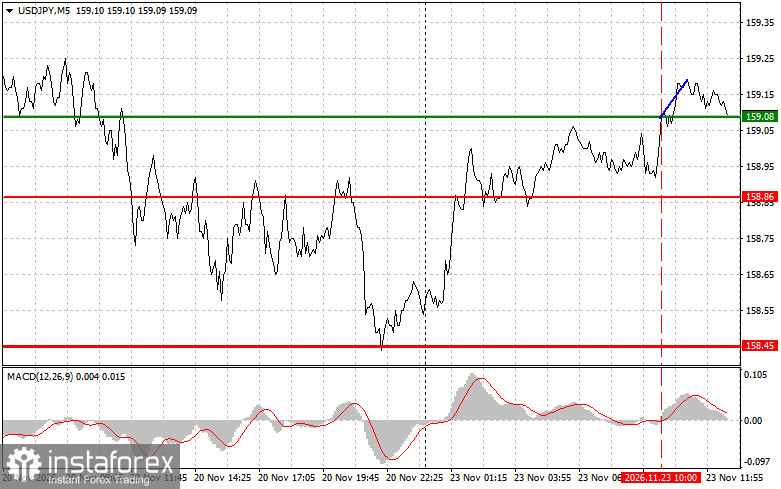
The test of the 159.08 level occurred when the MACD indicator had just begun moving upward from the zero line, confirming a valid entry point for buying the US dollar. However, the pair rose by only around 10 points.
The yen is beginning the week relatively stable, although continued strength in the US dollar remains a key downside factor. Japan is observing Labor Thanksgiving Day today, so trading during the Tokyo session is taking place under limited liquidity conditions. As a result, expectations regarding Bank of Japan policy and US economic data are becoming the key drivers for the yen. The prospect of an interest rate hike is supporting the Japanese currency. The Bank currently keeps its rate at 1.25% and left it unchanged on October 30. The vote was 8–1, with Takata opposing the decision to hold rates steady. Markets are now pricing in an approximately 86% probability of a rate hike on December 18.
There are sufficient reasons for these expectations. Japan's core consumer price index rose by 2.2% year over year in October, compared with a forecast of 2.3% and 2.1% in the previous month, marking its largest increase since December. Energy prices, which rose by 2.2%, and mobile communication costs, whose growth accelerated to 17.2%, made the largest contributions. Wages increased by 4.6% in September, the highest rate since 1997, while producer prices rose by 7.1% in October, against expectations of 6.5%. For the Bank of Japan, this means that price pressures remain elevated, supporting the case for further monetary policy tightening. However, weak GDP data, showing zero quarter-over-quarter growth in the third quarter against a forecast of 0.1%, and a 6.8% decline in household spending are adding to the need for caution.
In the second half of the day, however, market attention will shift to US business activity indices. The Manufacturing PMI is expected at 54.5, compared with 54.9 in October, while the Services PMI is forecast at 55.6, against 56.1 previously. No forecast is available for the Composite PMI; its previous reading was 55.9. Readings above 50 indicate expanding activity, and these levels suggest that the US economy is growing rapidly. It is important to remember that the preliminary October figures were higher than the final readings: the Services PMI came in at 57.9 versus 56.1, while the Composite PMI stood at 57.6 versus 55.9. The market will therefore be assessing how sustainable the expansion is. Strong data would reinforce expectations of a 25-basis-point Fed rate hike on December 9, which futures markets are already pricing in. Last week, Christopher Waller called for consideration of an even larger, 50-basis-point move. Strong figures could quickly restore the dollar's dominance and push yields higher.
As for the intraday strategy, the focus will be primarily on implementing Scenarios No. 1 and No. 2.
Buy Signal
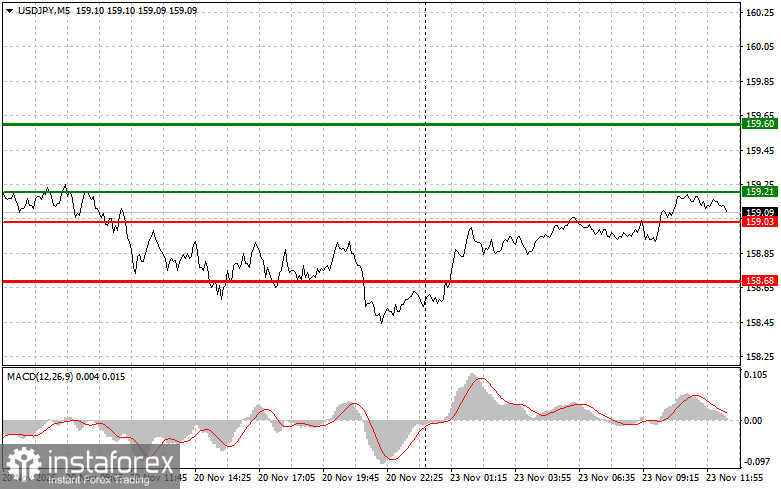
Scenario No. 1: Buy USD/JPY today when the price reaches the entry point around 159.21 (the thin green line on the chart), targeting a rise to 159.60 (the thicker green line on the chart). Around 159.60, close long positions and open short positions in the opposite direction, targeting a 30–35-point move away from that level. The pair is likely to rise today only if US economic data is strong. Important: Before buying, make sure that the MACD indicator is above the zero line and has only just begun moving upward from it.
Scenario No. 2: Buy USD/JPY today as well if the price tests the 159.03 level twice in succession while the MACD indicator is in the oversold area. This would limit the pair's downward potential and trigger an upward market reversal. A rise toward the opposite levels of 159.21 and 159.60 can be expected.
Sell Signal
Scenario No. 1: Sell USD/JPY today after the price moves below the 159.03 level (the thin red line on the chart), which could lead to a rapid decline in the pair. The sellers' key target will be 158.68. At that level, close short positions and immediately open long positions in the opposite direction, targeting a 20–25-point move away from the level. Selling pressure on the pair could return today if the central bank intervenes. Important: Before selling, make sure that the MACD indicator is below the zero line and has only just begun moving downward from it.
Scenario No. 2: Sell USD/JPY today as well if the price tests the 159.21 level twice in succession while the MACD indicator is in the overbought area. This would limit the pair's upward potential and trigger a downward market reversal. A decline toward the opposite levels of 159.03 and 158.68 can be expected.
What Is Shown on the Chart
- Thin green line – the entry price at which the trading instrument can be bought.
- Thick green line – the estimated price at which Take Profit orders can be placed or profits can be closed manually, as further gains above this level are unlikely.
- Thin red line – the entry price at which the trading instrument can be sold.
- Thick red line – the estimated price at which Take Profit orders can be placed or profits can be closed manually, as further declines below this level are unlikely.
- MACD indicator. When entering the market, it is important to take overbought and oversold zones into account.
Important. Beginner Forex traders should exercise extreme caution when making market entry decisions. It is best to stay out of the market ahead of the release of major fundamental reports to avoid exposure to sharp exchange rate fluctuations. If trading during news releases, always use Stop Loss orders to minimize potential losses. Without Stop Loss orders, the entire trading account can be lost very quickly, especially when large position sizes are used without proper money management.
Remember that successful trading requires a clear trading plan, such as the one outlined above. Making spontaneous trading decisions based on current market conditions is a fundamentally losing strategy for an intraday trader.