


















Oil continued to decline today after falling more than 3% in the previous session. Brent trades around $89 per barrel, and WTI has fallen below $80. The slide was supported by cautious hopes that the U.S. and Iran may find a way to end the war.
The catalyst was a meeting between Vice President J.D. Vance and Qatar's prime minister, a mediator in the nearly nine-month conflict. Donald Trump has held back from new strikes since the Democrats' midterm victories, although smaller clashes have become more frequent. Note how his stance has shifted: on November 4 he said there were no immediate plans to strike; on November 12 he said he did not need a deal with Tehran; on November 20 he said he was in no rush to decide. Over the weekend, Trump said he might resume strikes after the New Year if talks fail.
Supply, meanwhile, is rising. Despite fighting and frequent attacks on tankers in the Strait of Hormuz, crude exports from the Persian Gulf have increased materially. The IEA expects the market to move into surplus this quarter, and Goldman Sachs warns global surplus risks next year.
Price dynamics show the scale of the decline. Brent was $116.06 on October 30, fell to $94.62 by November 4, rose to $99.93 on November 6 and was $95.70 on November 13. Last week oil hovered around $92, and since the end of October Brent has lost more than one-fifth of its value. WTI was about $84.97 on November 17 and has also fallen sharply.
The pressure on prices is not final. Major disagreements remain. Tehran demands the removal of the U.S. maritime blockade of its ports, sanction relief, and the unfreezing of assets before fully reopening Hormuz. Washington seeks concessions on Iran's nuclear program. Risks persist: Iran attacked Bahrain again, Houthi forces continue strikes on Saudi Arabia, and oil still carries an escalation premium.
Cheaper oil matters for the Federal Reserve. New York Fed President John Williams said on Monday that a further rise in gasoline prices would be one condition for consecutive rate hikes — gasoline has fallen to about $3.75 from $4.12 on November 6. Lower oil helps cool inflation, though Wednesday, November 25's October PCE release will show how quickly.
All this suggests oil will stay under pressure in the near term while hopes for talks persist and Gulf exports rise. The market appears to be pricing in peace faster than the parties are moving toward it, so any breakdown of talks or a new escalation would quickly restore the premium and halt the decline.
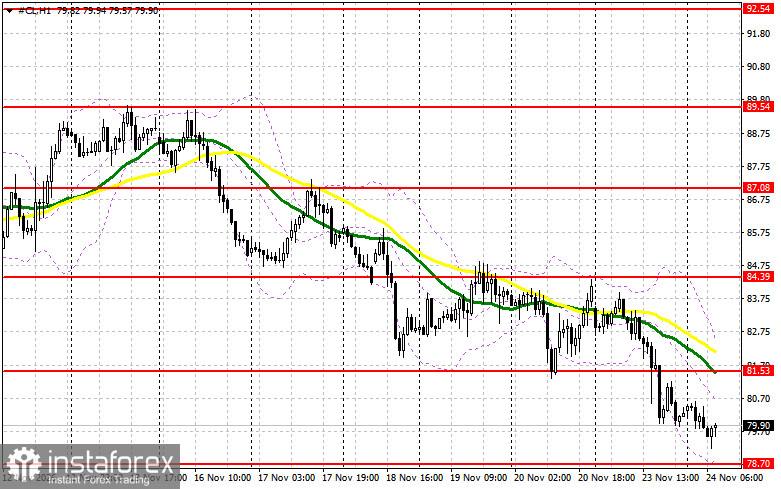
Technical picture: buyers need to take near resistance at $81 to target $85, above which a breakout will be difficult. A further target is around $87. On the downside, bears will try to seize control below $78; if they succeed, a range breakout would hit bulls hard and push oil toward $76, with scope to reach $74.