


















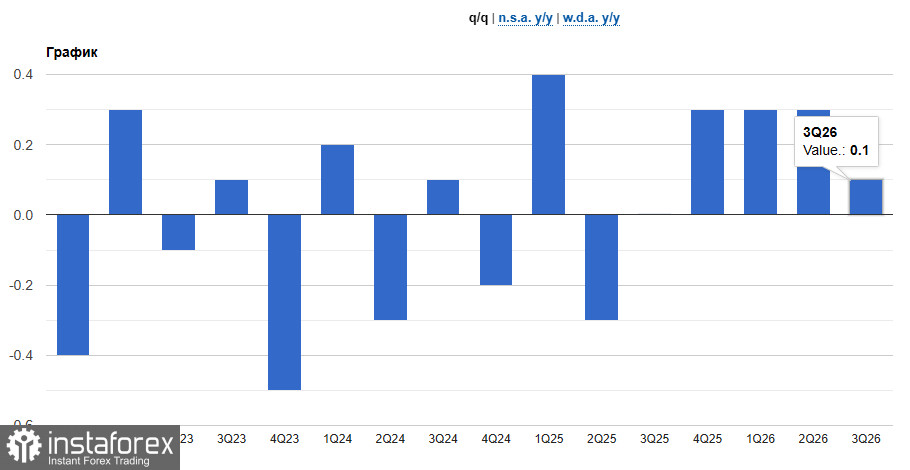
Germany entered autumn nearly idling. Today's data shows that Q3 2026 GDP rose just 0.1% q/q (price-, seasonal-, and calendar-adjusted), revised down 0.1 ppt from Destatis's October 30 preliminary 0.2%, and below analysts' 0.1% expectation. The revision reflects weaker-than-expected export and retail outturns in September. On an annual basis, the picture remained roughly intact: +1.2% (price-adjusted) and +1.1% with calendar effects, slightly above the 1.1% consensus and materially higher than the prior 1.0% reading.
Looking at recent quarters, the economy has clearly lost steam. Q4 2025 posted +0.3%, early 2026 accelerated to +0.4%, then slowed to +0.3%, and now barely reached +0.1%. In the second and third quarters of 2025, the economy was essentially flat. "Economic growth slowed in the third quarter," Federal Statistical Office President Ruth Brand said, noting that Germany had held up reasonably well in the first half of the year despite geopolitical shocks.
Household demand was not the rescuer. Final consumption rose just 0.1%, the same pace as the previous quarter, and households (about 70% of consumption) added only 0.1%. Purchases of short-lived goods, including food and energy such as motor fuel, were even more subdued than in the second quarter. The only material driver was government spending, which increased 0.3%.
The main blow came from business. Gross fixed capital formation fell 1.2%, with machinery & equipment investment plunging 3.5%. New commercial vehicle registrations also declined. The downward trend visible in the first half of the year not only persisted but intensified. Construction fell modestly, down 0.3%, appearing more a minor wound than a structural collapse.
External trade also weakened. After robust export and import growth in the first half of the year, volumes turned down in Q2–Q3 and exports fell 1.0% in Q3. Goods exports declined 0.8%, notably cars, trailers, chemicals, and metals, while services exports fell 1.7%. Goods imports dropped 1.5%, services imports 1.1%, and total imports fell 1.4%, with particularly notable reductions in purchases of vehicles, machinery, and chemicals.
A warning had already been issued. In October, the Bundesbank flagged a likely Q3 stagnation, citing short-term factors such as low Rhine water levels, while expecting stronger growth in October-December. Relative to the eurozone, Germany looks like a laggard: Eurostat confirmed euro-area Q3 GDP up 0.4% q/q (+1.3% y/y) on November 13. Inflation in Germany remains well below the eurozone average — October CPI at 2.8% vs. 4.0% HICP for the eurozone — while producer prices rose 1.4% m/m in October.
All this suggests that weak Q3 data is unlikely to stop the ECB from raising interest rates. Euro-area inflation is 4.0%, and Bundesbank president Nagel described a December hike as a strong signal of resolve. I expect the deposit rate to rise from 2.50% to 2.75% on December 17, and Germany, judging by leading indicators, should post growth above 0.1% in Q4. For the euro, this GDP print is broadly neutral. In my view, the near-term direction will still be set by the dollar, and with Fed rate hike expectations, EUR/USD remains below 1.10.
EUR/USD
Buyers should look to take 1.0960. Only that would open a test of 1.1005. From there, a run at 1.1040 is possible, but doing so without support from large players will be difficult. On a pullback, I expect increased buying activity only near 1.0925. If bids are absent there, wait for a drop to a new low at 1.0880 or consider long positions at 1.0850.
GBP/USD
Pound buyers need to overcome the immediate resistance level of 1.3100. That would enable a move toward 1.3140, above which further gains would be challenging. The next upside target is around 1.3175. On a decline, bears will try to seize 1.3060. If they succeed, a range break would inflict serious damage on bulls and push GBP/USD down to 1.3015, with the prospect of extending the decline to 1.2975.