


















Gold (XAU/USD) has remained under pressure for the second consecutive day. Prices are still trading near the $3,500 level, close to their lowest levels since the beginning of the year, as the fundamental backdrop remains unfavorable. Hawkish rhetoric from Federal Reserve (Fed) officials continues to weigh on the precious metal, which offers no interest income. At the same time, rising geopolitical tensions in the Middle East have once again boosted demand for the US dollar as a safe-haven asset, following the previous day's retreat in the US currency from its highest levels since March 2025.
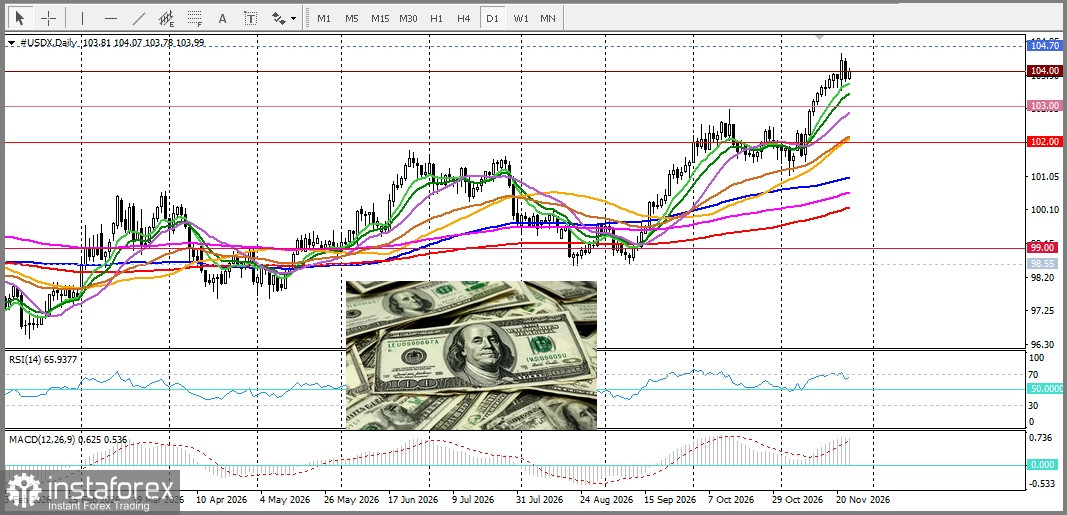
This has become an additional negative factor for gold, supporting sellers. Nevertheless, a sustained move below the psychologically important $3,500 level would be required to provide definitive confirmation of the bearish scenario.
According to CME Group's FedWatch Tool, market participants have almost fully priced in a 25-basis-point Fed rate hike in December. In addition, investors are considering the possibility of further monetary policy tightening in early 2027. These expectations strengthened after John Williams, President of the Federal Reserve Bank of New York, stated on Monday that the central bank still had considerable work to do to bring inflation back to its 2% target. The US dollar also received additional support from an increase in the Conference Board Consumer Confidence Index to its highest level in nearly two years, indicating improved assessments of labor market conditions and the US economy as a whole.
However, dollar bulls are likely to remain cautious ahead of the release of key US macroeconomic data. During the North American trading session, the Personal Consumption Expenditures (PCE) Price Index will be released. This is the primary inflation indicator considered by the Fed when making monetary policy decisions. The second estimate of US GDP for the third quarter is also due. These releases could prompt a reassessment of market expectations regarding the future path of Fed monetary policy, thereby affecting demand for the US dollar and potentially setting a new direction for gold prices. Meanwhile, further escalation of geopolitical tensions, amid increasingly frequent attacks on vessels near the Strait of Hormuz and the lack of significant progress toward a diplomatic resolution of the conflict between the United States and Iran, is likely to continue supporting the US dollar while limiting the upward potential of the precious metal.
In particular, Iran's Islamic Revolutionary Guard Corps (IRGC) reported an attack on a container ship that, according to the organization, was illegally transiting this strategically important waterway. At the same time, Tehran-backed Houthis threatened to strike Saudi Arabia's port infrastructure along the Red Sea coast in response to an attack by a Saudi-led coalition on the Yemeni port of Hudaydah. This situation is sustaining the geopolitical risk premium and supporting the US dollar. As a result, any recovery in gold prices is likely to attract renewed selling pressure, limiting further upward potential. Meanwhile, traders anticipating lower prices may prefer to wait for a break below the psychological $3,500 level before opening new short positions.
In the short term, XAU/USD maintains a bearish bias, trading below all major moving averages. Oscillators remain in negative territory, confirming the advantage of sellers. However, the Relative Strength Index (RSI) is in oversold territory, suggesting that selling pressure may be weakening rather than indicating a confirmed trend reversal in favor of buyers. The nearest resistance level is at $3,700, followed by $3,800. The 20-day Simple Moving Average (SMA) lies above these levels. Support remains in the zone slightly below $3,500.