


















Trade analysis and tips for trading the European currency
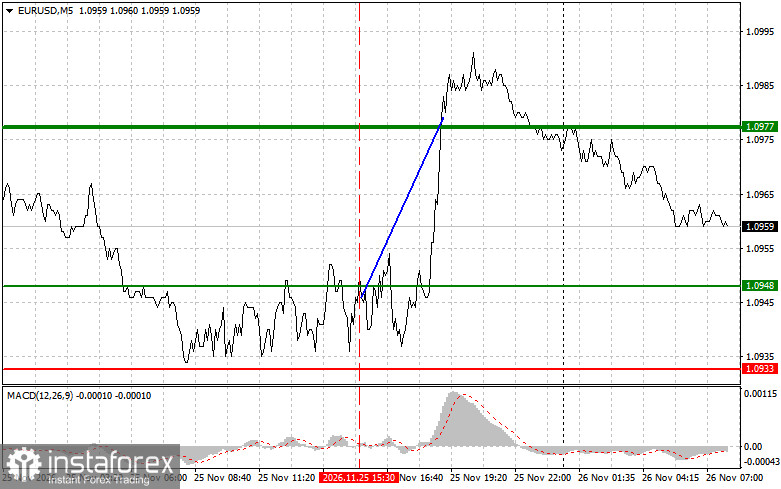
The price test at 1.0948 occurred as the MACD indicator began moving up from the zero line, confirming a good entry point to buy the dollar. As a result, the pair rose toward the target level of 1.0977.
Put simply, yesterday's U.S. figures say one thing: the U.S. economy is growing faster than expected. Prices are also still rising too quickly. Q3 GDP was revised to 4.3% from 3.4%, and the Personal Consumption Expenditures index, which the Federal Reserve considers the main measure of inflation, was 3.3% year-on-year in October versus a 3.2% forecast. The Fed's inflation target is 2%, and we're still far from it. Initial jobless claims fell to 189,000, so there is no mass layoff wave, and new-home sales were 701,000 versus a 650,000 forecast, meaning homebuyers are returning even with expensive mortgages.
This matters for the dollar and the Fed for a simple reason. When the economy grows quickly and inflation remains high, the central bank has no grounds to ease policy, so a 25-bp rate hike at the December 9 meeting remains the main scenario. John Williams on November 23 did not rule out hikes at several consecutive meetings. Yet the dollar did not rise on these figures, apparently because the market had already priced in a hawkish Fed.
Today the key event for the euro will be the European Central Bank minutes from the October 29 meeting. This is a detailed record of the discussion showing what council members debated, which arguments favored a rate rise, and how they assessed the risks. The market expects a hawkish tone, since several officials have supported tightening since then. On November 19, Joachim Nagel called a December hike a firm signal of determination, and ECB Vice-President Vujcic and Chief Economist Philip Lane also consider it likely. Recall that euro-area inflation was 4.0% in October and core inflation 2.6%, and such figures leave little room for doubt.
In the first half of the day, attention will also fall on data. Germany's GfK consumer climate index for December is expected to improve to -29.4 from -30.8, which matters after yesterday's weak GDP, which rose only 0.1% versus a 0.2% forecast. Private sector lending and M3 for October will complete the picture, since in September they were 3.1% and 3.5%; an acceleration would confirm that demand for money in the economy persists.
For intraday strategy, I will rely more on executing scenarios No. 1 and No. 2.
Scenarios for Buying
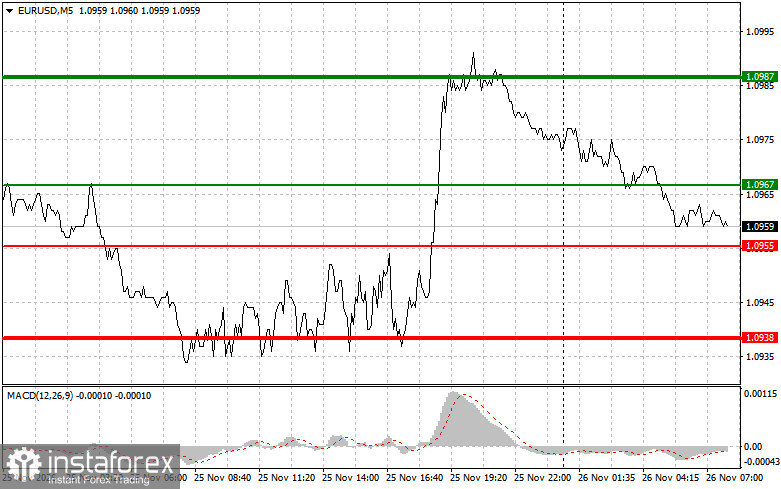
Scenario No. 1: Today you can buy the euro when the price reaches around 1.0967 (the green line on the chart), targeting a rise to 1.0987. At 1.0987, I plan to exit the market and also sell the euro in the opposite direction, expecting a 30–35 pip move from the entry point. You can count on the euro rising today only after good data. Important! Before buying, make sure the MACD indicator is above the zero line and is just beginning to rise from it.
Scenario No. 2: I also plan to buy the euro today if it tests 1.0955 twice in a row while the MACD indicator is in the oversold area. This will limit the pair's downside potential and lead to an upward reversal. You can expect a rise to the opposite levels 1.0967 and 1.0987.
Scenarios for Selling
Scenario No. 1: I plan to sell the euro after it reaches the 1.0955 level (the red line on the chart). The target will be 1.0938, where I intend to exit the market and immediately buy in the opposite direction (expecting a 20–25 pip move back from that level). Pressure on the pair will return if data is weak. Important! Before selling, make sure the MACD indicator is below the zero line and is just beginning to fall from it.
Scenario No. 2: I also plan to sell the euro today in the event of two consecutive tests of 1.0967 when the MACD indicator is in the overbought area. This will limit the pair's upside potential and lead to a downward reversal. You can expect a decline to the opposite levels of 1.0955 and 1.0938.
What's on the Chart:
Thin green line – the entry price at which you can buy the trading instrument;
Thick green line – the suggested price where you can place a Take Profit or manually lock in gains, since further upside above this level is unlikely;
Thin red line – the entry price at which you can sell the trading instrument;
Thick red line – the suggested price where you can place a Take Profit or manually lock in gains, since further downside below this level is unlikely;
MACD indicator. When entering the market, it is important to follow the overbought and oversold zones.
Important. Beginner Forex traders must be very cautious when making entry decisions. Before the release of important fundamental reports, it is best to stay out of the market to avoid getting caught in sharp price swings. If you decide to trade during news releases, always place stop orders to minimize losses. Without stop orders, you can quickly lose your entire deposit, especially if you don't use money management and trade large volumes.
Remember, successful trading requires a clear trading plan, like the example I presented above. Spontaneous trading decisions based on the current market situation are a losing strategy for an intraday trader from the start.