


















The Fed's preferred inflation gauge rose again, and American consumers felt it at the checkout. The PCE price index climbed 0.3% in October month-on-month and 3.8% year-over-year, up from 3.6% in September and 3.4% in August. Inflation has accelerated for three consecutive months, and the dollar didn't notably benefit, which is telling, even though at first glance the data should have supported the greenback.

The core PCE price index, which excludes food and energy and is the Fed's focal point for policy decisions, also rose 0.3% m/m and 3.3% y/y, versus 3.1% in September and 3.0% in August. With that trajectory, arguments for a pause in December look increasingly weak: the October FOMC minutes already showed nearly all participants viewing another hike as appropriate.
Household incomes rose sharply in October. Personal income increased by $201.8 billion (+0.7% m/m), and disposable personal income after taxes rose by $200.5 billion (+0.8% m/m). Wage and compensation growth, government transfer payments, and asset income were the main drivers. Given the October payrolls surprise (+165k vs. +65k forecast), this income strength is a natural continuation of labor market momentum.
Spending was more subdued. Nominal personal consumption expenditures rose $63.8 billion, or 0.3% m/m — $11.8bn in goods and $52.1bn in services. But after adjusting for prices, real consumer spending fell by $5.8bn in October, down marginally (less than 0.1%). In plain terms, Americans paid more for roughly the same basket and bought slightly less than in September.
The gap between incomes and spending widened. Personal outlays rose $69.3bn overall, and personal savings amounted to $1.00 trillion, giving a savings rate of about 4.1% of disposable income. That implies households retain some capacity to spend, and with consumer confidence near a nearly two-year high, the holiday season could be relatively robust.
For the Fed, the mix is uncomfortable. The funds rate sits at 3.75–4.00%, and markets price in a 25-bp hike for December 8–9 — a move that is largely priced in — while John Williams on November 23 left open the possibility of consecutive rate hikes. Price pressure remains: producer prices rose 6.5% y/y in October, the highest since November 2022, and there is no obvious reason for the Fed to adopt a softer tone while the PCE price index is rising.
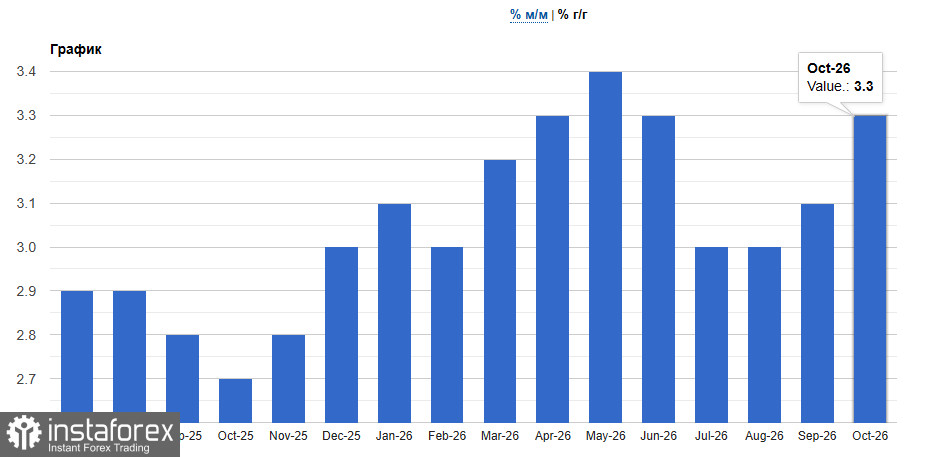
Why didn't the dollar rally? My read is that a December hike is already priced in, the US dollar index sits near its April 2025 highs, and real consumer outlays fell — so the data is not an unambiguous hawkish surprise. The market is asking whether high inflation will start to erode demand, and that uncertainty has kept investors from piling into dollar positions.
This indicates that the Fed will likely hike interest rates on December 9, but the dollar's reaction will remain muted until the market sees whether consumers can withstand this inflation. The key test is the November jobs report on December 4. If it confirms labor market strength, pressure on the Fed to tighten further will rise. If real spending continues to fall, the growth-slowdown scenario will gain traction, and the dollar could lose support.
EUR/USD
Buyers should consider taking 1.0990. Only that would open a test of 1.1030. From there, a run to 1.1060 is possible, but doing so without large-player support will be difficult. On a pullback, buying activity is likely to increase only near 1.0940. If bids are absent there, wait for a drop to a fresh low at 1.0890 or consider long positions at 1.0850.
GBP/USD
Pound buyers need to overcome the nearest resistance level of 1.3140. That would enable a move toward 1.3170, above which further gains would be challenging. The next upside target is around 1.3200. On a decline, bears will try to seize 1.3090. If they succeed, a break below that level would deal a serious blow to bulls and push GBP/USD to 1.3050, with the prospect of extending the decline to 1.3010.