


















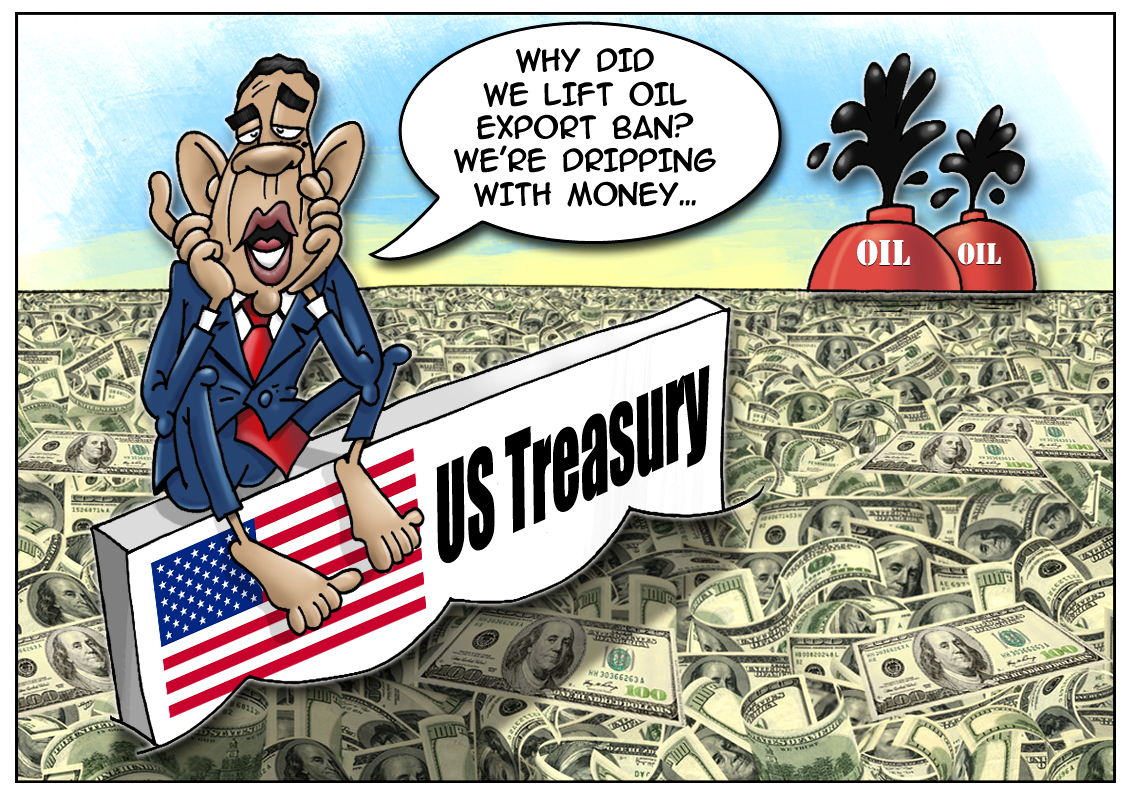
New York could add 15,350 jobs and $1 trillion to the state economy if crude exports were lifted. Besides, the U.S. is poised to become the world’s largest oil producer. So, why not focus attention on export sales of domestic crude instead of searching oil around the world? Experts of the IHS analytical agency are sure that the U.S. budget could be supplemented with over $1.3 trillion in the period from 2016 to 2030. According to a scenario suggested by the HIS specialists, lifting the export moratorium will pump up the oil output to 11.2 million bpd whereas the current oil output is hovering near 8.2 million bpd. Moreover, investments are expected to boost. So, it would lead to a total of $746 billion in additional investment to be allocated for large-scale infrastructure projects in the gas and oil industry. “The benefits of this in terms of investment would flow through to the entire economy in a pretty significant way,” said Daniel Yergin, IHS Vice Chairman and energy writer. To prove his point, the official refers to the results of the fracking revolution which has pushed domestic production of oil and gas to record levels not seen in decades. Thus, shale gas and oil production is one of the key factors of the U.S. economic recovery after the financial crisis which accounts for 1% of the GDP for the recent two years. Importantly, Energy Policy and Conservation Act passed in 1975. It restricted crude oil exports thus responding to the 1973 oil crisis as a preventive mechanism. At that time, Arab OPEC countries refused to supply oil to those countries which supported Israel in its conflict with Syria and Egypt. The global oil market reacted by an abrupt spike in crude oil prices. Thus, crude inflated to $12 bpd from $3 bpd. This caused the energy crisis in numerous countries, including the U.S. Nowadays American crude is exported just to Canada and Mexico only under special licenses.


