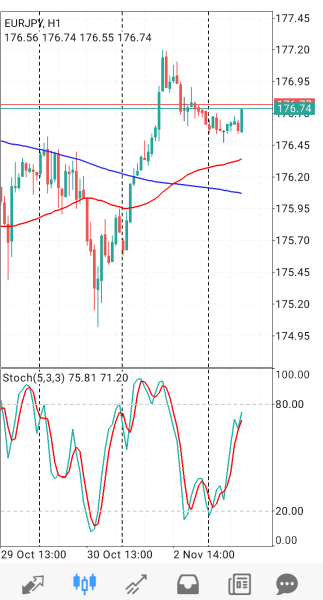
Using the EURJPY H1 timeframe chart, the current price movement shows a bullish tendency after a strong rebound from the 175.10–175.20 area. The last price is around 176.74, with the movement structure showing the formation of a higher low and a significant rise reaching the 177.15–177.20 area. This condition indicates that buyers still have strength, although the price is currently consolidating after the sharp rise. From the moving average side, the red MA has started to slope upward and is below the price, indicating increased short-term bullish momentum. Meanwhile, the blue MA is still below the price but tends to slope downward, so the previous trend has not fully turned into a strong bullish one. The crossovers and direction of both moving averages should be monitored for further confirmation. The Stochastic indicator (5,3,3) shows values around 75.81 and 71.20. Both lines are moving up approaching the overbought area. This indicates that buying momentum is starting to increase, but there is potential for a correction if the price fails to break the nearest resistance. The main strategy that can be applied is BUY ON PULLBACK, by waiting for the price to correct first toward the 176.55–176.60 support area. A buy entry can be considered if a bullish candle appears as confirmation of price rejection in that area. The first profit target is at 176.95, while the next target is at 177.15–177.20. A stop loss can be placed below the 176.40 support to limit risk. Alternatively, if the price manages to break the 176.80–176.85 resistance and the H1 candle closes strongly above that area, traders can consider a breakout buy strategy by waiting for a retest as confirmation. Conversely, if the price breaks the 176.50 support and closes below it, the bullish scenario should be reevaluated. A potential correction may head toward 176.20 down to 175.95. Conclusion: EURJPY H1 still has bullish potential, but the price is consolidating and the Stochastic is approaching overbought. Prioritize buy on pullback or a confirmed breakout. Avoid rushed entries and always use risk management with a minimum risk-reward ratio of 1:2.