


















It is expected that weak data on industrial production in Germany put pressure on the European currency in the morning. The report showed a likely slowdown not only in industrial production but also in the country's economy as a whole. Yesterday's data on the growth of orders in the manufacturing sector did not help either, as the growth of inventories continues to increase, which does not bode well for production in the next few months.
The main problem remains trade conflicts and the protracted situation with Brexit. The report also focuses on major structural changes in the automotive industry, which further overshadows the prospects for further growth. All this once again suggests that the German economy will show weaker growth in the 2nd quarter of this year than previously expected.
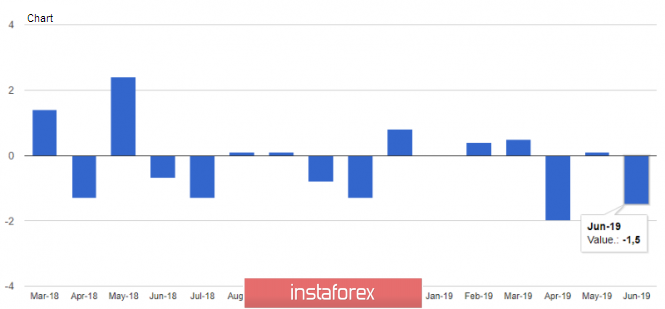
According to the report of the Federal Bureau of Statistics of Germany, industrial production in Germany in June this year decreased more than expected. Thus, industrial production fell by 1.5% in June compared to May, while economists had forecast a decrease of 0.3%. As noted above, the main decrease in activity was noted in mechanical engineering and metallurgy. The growth of production was noted in the construction sector by 0.3%, and a particularly large reduction was recorded in the manufacturing industry, where the decline was 1.8%. Compared to the same period in 2018, production fell by 5.2%.
However, closer to the opening of the North American session, the pressure on the euro eased, leaving a fairly good short-term outlook for the growth of risky assets. As for the technical picture of the EURUSD pair, at the moment, the buyers' task is to return to the resistance of 1.1220, the breakdown of which will return to the market players who are betting on strengthening risky assets, and will lead to an update of the monthly highs in the area of 1.1290 and 1.1240.
Today, a report on crude oil reserves in the US is expected, which can support oil quotes, which are falling for the third day in a row. Oil reserves in the US are expected to decline last week. Forecasts range from -400,000 barrels to -6.5 million barrels. In the case of a larger, beyond the forecasts of analysts, the reduction of oil reserves on the WTI brand can go back to the area of 53.50 dollars per barrel. Larger support, in the case of a bearish trend, can be seen starting from the level of 51.40 and ending with a minimum of June 12 - 50.70.


