


















While the US dollar continues to face challenges due to weak fundamental data, Minneapolis Federal Reserve Bank President Neel Kashkari stated yesterday that interest rates may currently be near a neutral level, and future actions by the central bank will depend on incoming economic data.
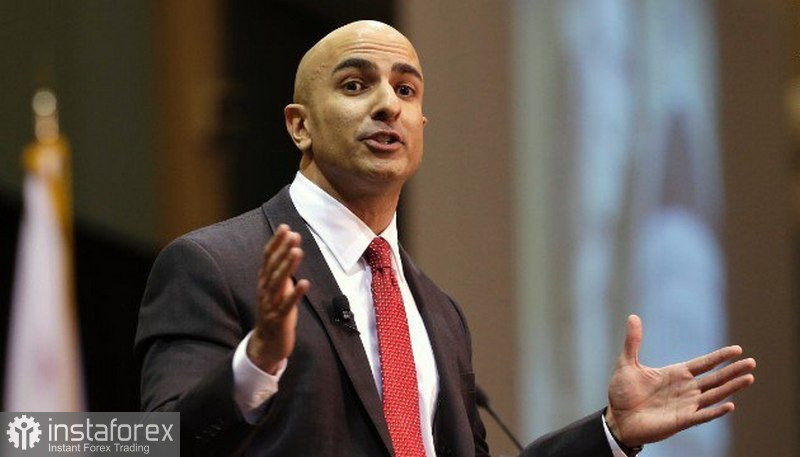
"In recent years, we've consistently thought that the economy would slow down, but it has proven to be much more resilient than I expected," Kashkari said on CNBC on Monday. This year, he will again serve as a voting member of the Fed.
His statement has added fuel to the debate about the future path of Fed monetary policy and heightened investor concerns about the prospects for the US economy. Essentially, Kashkari's remarks cast doubt on further plans by the Fed to ease monetary policy. If interest rates are indeed near neutral, any further changes could increase inflationary pressure. Market participants took this as a cautionary signal and revised their forecasts for future Fed actions.
"This tells me that monetary policy apparently is not exerting strong downward pressure on the economy. I think we are close to a neutral position right now," Kashkari added.
Currently, everyone expects that the Fed will likely keep interest rates unchanged this month after three consecutive cuts at the end of 2025. Most Fed officials believe that rates will be lowered in the future as inflation declines, but they differ on when and how much to cut.
Economic data released after the December Fed meeting showed that unemployment rose to 4.6% in November—the highest level since 2021—while consumer prices increased less than expected, reinforcing arguments for rate cuts. However, the economy also grew in Q3 at its fastest pace in two years, raising concerns about a potential return of inflation.
"We just need to gather more data to understand which force is stronger—inflation or the labor market—so we can move from a neutral stance to whatever direction is necessary," Kashkari said. "The risk of inflation is its lingering nature—the effects of tariffs may only show in the system after several years, while I believe there is already a risk of a sudden increase in unemployment," he added.
Technical Outlook for EUR/USD
Buyers should focus on capturing the 1.1750 level. Only after this can they aim to test 1.1780. From there, the next target is 1.1810, although reaching it without support from major market participants will be difficult. The farthest target is 1.1840.
If the pair declines only to around 1.1715, I would expect some significant activity from large buyers. If no one steps in, it may be better to wait for a retest of the 1.1685 low or to open long positions from 1.1660.
Technical Outlook for GBP/USD
Pound buyers need to capture the nearest resistance at 1.3560. Only after that can the pair target 1.3590, above which further gains will be challenging. The farthest target is 1.3625.
If the pair falls, bears will attempt to take control at 1.3530. If successful, breaking this range would seriously hurt bullish positions and push GBP/USD toward the 1.3500 low, with the potential to reach 1.3470.


