


















Stock indices closed with another wave of selling yesterday. The S&P 500 dropped by 0.94%, the Nasdaq 100 plunged by 1.02%, and the Dow Jones Industrial Average fell by 0.83%.

A dramatic 8% plunge in Thailand's stock market earlier today, which triggered a trading halt, highlighted how the Middle East escalation has dented investor sentiment. The move was not entirely surprising given Thailand's vulnerability to external shocks, particularly those tied to energy prices. The country's heavy dependence on oil imports makes it especially sensitive to price spikes driven by regional geopolitical conflict.
Thailand's sell-off is just the tip of the iceberg. Asian markets are broadly being swept up in a major sell-off. Faced with rising uncertainty about the duration and fallout from the US-Iran conflict, investors are pulling money out of risky assets and seeking refuge in more predictable instruments. Troubling headlines from the Middle East have erased some of the AI-driven optimism that previously supported Asian markets, forcing a reassessment of investment strategies toward lower risk.
What is unfolding illustrates how the Middle East conflict has globalized its impact. Economies that appear distant from the epicenter are coming under pressure via supply-chain disruptions, price shocks and a generalized drop in risk appetite. Events like these starkly show the interconnectedness of the modern world and how quickly a local geopolitical crisis can morph into a global economic problem.
Rising energy prices — a direct consequence of heightened Middle East tensions — have immediately stoked justified fears of renewed inflation worldwide. That inflationary impulse, in turn, can put additional pressure on equity markets across Europe and the United States. Confronted with the prospect of asset depreciation and falling purchasing power, investors tend to trim risk exposures, driving further sell-offs.
The situation is compounded by the Federal Reserve's hawkish stance. The regulator, despite potential negative implications for the stock market, shows no signs of materially easing policy. Fed officials' remarks increasingly stress the need to keep interest rates elevated to combat existing inflation. That commitment to tight policy adds direct pressure on equity buyers, making more conservative investments such as bonds relatively more attractive. This dynamic creates an unfavorable backdrop for an equity rally by constraining the cheap-money impulse that typically fuels gains.
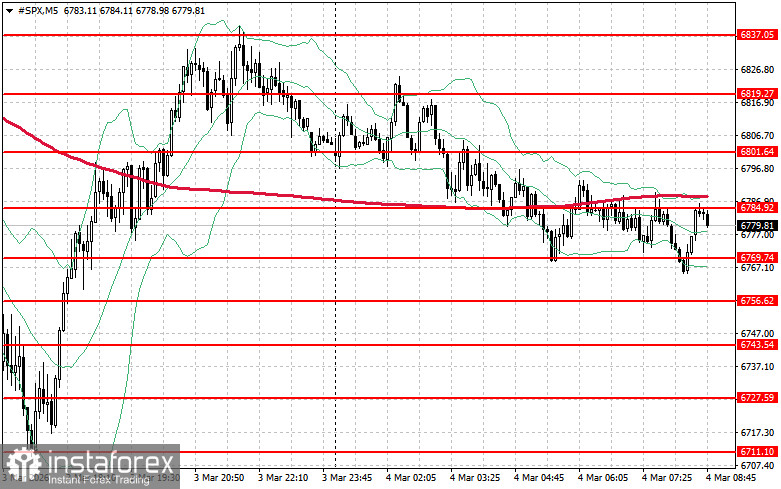
As for the S&P 500 technical analysis, buyers' near-term task is to overcome the immediate resistance level of $6,784 to gain renewed upside momentum and open the way to $6,801. Gaining control of $6,819 would further bolster the bullish case. On the downside, buyers should defend around $6,769. A break below that level would quickly bring the instrument back down to $6,756 and could open the path to $6,743.


