


















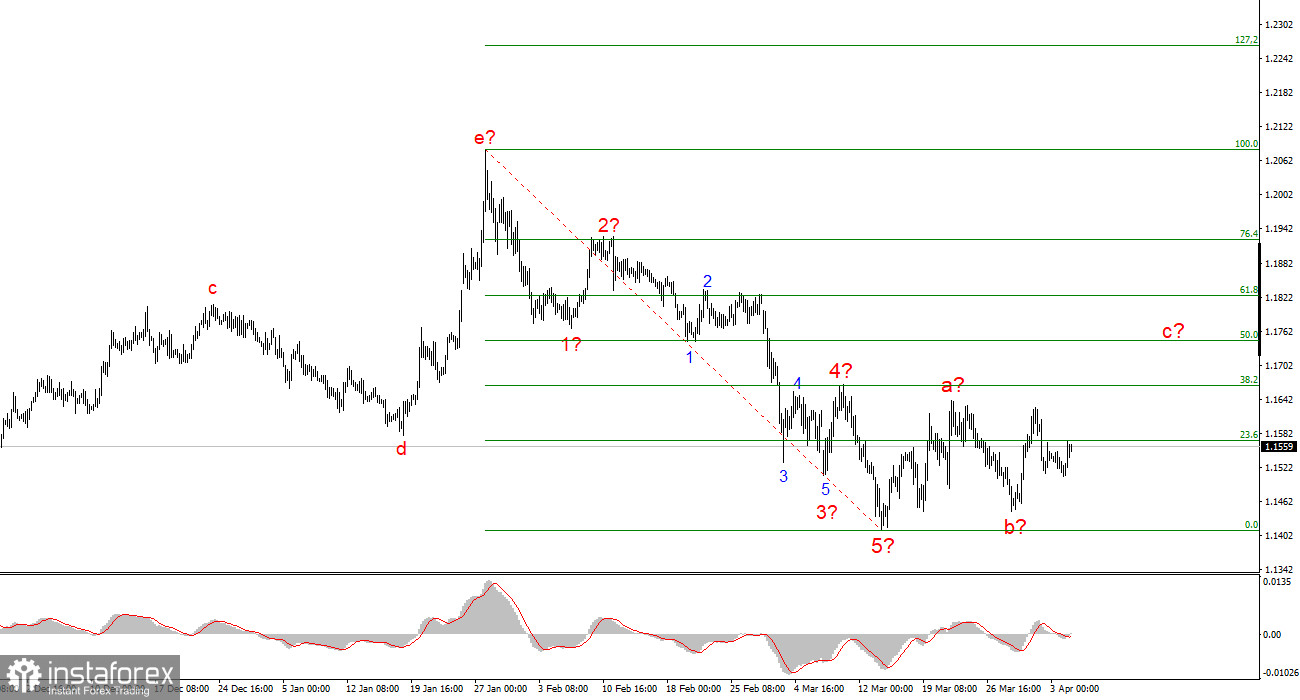
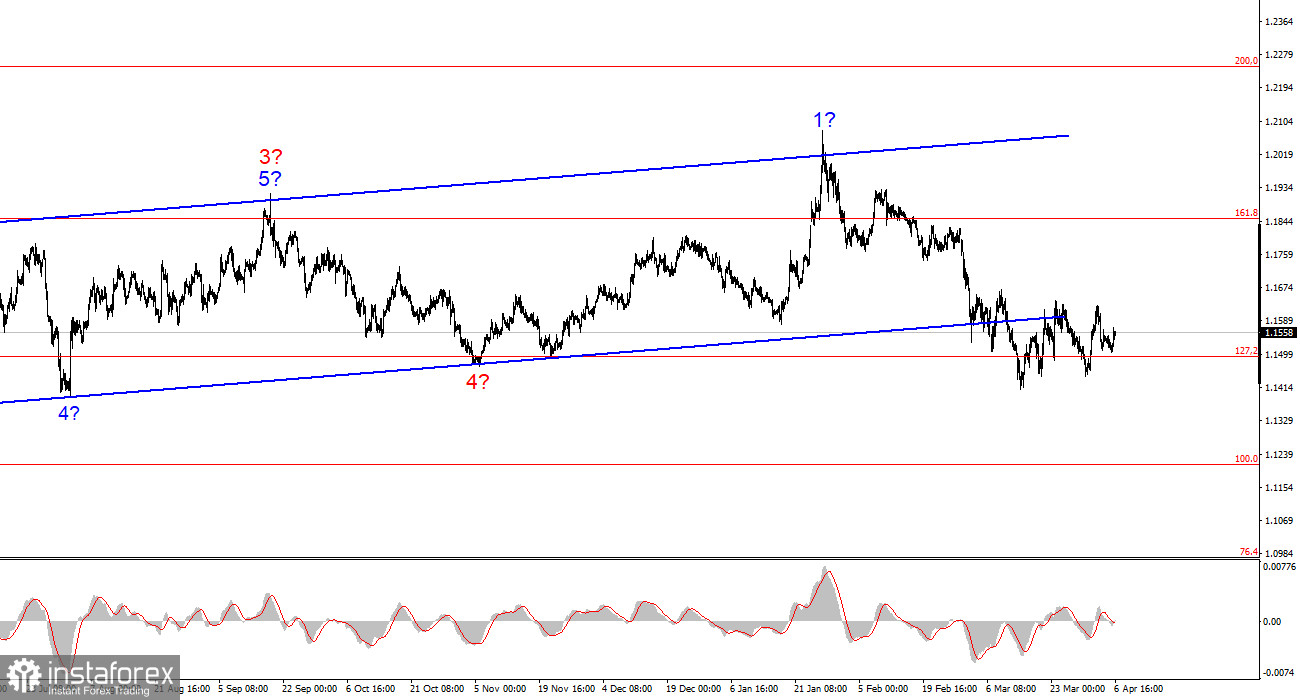
The wave pattern on the 4-hour chart for EUR/USD has changed. There is still no talk of canceling the upward trend segment (lower chart), which began in January last year, but the wave structure now looks very ambiguous. In such situations, I always recommend switching to a lower timeframe (upper chart) and focusing on the simplest and smallest wave structures in order to make a short-term forecast, which is sufficient for opening trades. Wave structures can be very complex and allow for many different scenarios. The easiest way to trade is by following the standard "five-three" pattern.
In the chart above, I can identify a classic five-wave impulsive structure with an extended third wave. If this is indeed the case, then this structure has been completed, and we can expect the formation of a corrective sequence of at least three waves. Therefore, in the near future, we should expect the instrument's quotes to rise, but within a correction relative to the latest trend segment. For now, recent wave structures fit poorly into the higher-level count, but the situation should become clearer over time. In the near term, a recovery of the euro toward the 1.1666 and 1.1745 levels can be expected.
The EUR/USD pair rose by 40 basis points on Monday, although another decline would not have been surprising. As early as Friday, the pair could have dropped about 100 points on very strong and positive U.S. labor market data. Personally, I am not satisfied with the explanation of "Easter." The market completely ignored not just strong reports, but reports that supported the U.S. dollar. Therefore, the downward impulse has likely run out of steam.
Donald Trump may disagree, as he could launch another strike on Iran at any moment. However, the market is gradually moving away from "trading on Trump." The U.S. dollar undoubtedly remains the safest asset, but it is worth remembering that a flight to the dollar is typical only in the early stages of difficult geopolitical periods. Later, investors redirect their funds into assets that can not only provide protection but also generate returns. Therefore, at this moment, the U.S. dollar may have exhausted its momentum.
Over the past two months, in my opinion, enough weak data has come from the U.S. to bring buyers back into the market. Now we are seeing passivity from sellers, even though the situation in the Middle East is not improving and labor market data has, for the first time in a long while, turned positive. Based on all of the above, I believe that the corrective structure will continue to develop. Consequently, I expect the instrument to rise toward the 1.17 level.
General Conclusions
Based on the analysis of EUR/USD, I conclude that the instrument remains within an upward trend segment (lower chart), while in the short term it has completed a downward wave sequence. Since the five-wave impulsive structure is complete, in the coming week readers can expect price growth toward targets around 1.1666 and 1.1745, which correspond to the 38.2% and 50.0% Fibonacci levels. Further movement will depend entirely on events in the Middle East.
On the smaller timeframe, the entire upward trend segment is visible. The wave structure is not entirely standard, as corrective waves differ in size. For example, the higher-degree wave 2 is smaller than the internal wave 2 within wave 3. However, such situations do occur. Let me remind you that it is better to identify clear and understandable structures on charts rather than strictly tying analysis to every wave. The trend may reverse in the near future.
Core Principles of My Analysis:
- Wave structures should be simple and clear. Complex structures are difficult to trade and often subject to change.
- If there is no confidence in what is happening in the market, it is better to stay out.
- Absolute certainty about market direction is impossible. Always use protective Stop Loss orders.
- Wave analysis can be combined with other types of analysis and trading strategies.


