


At the center of the spy scandal was the long-time leader of the semiconductor boom — Nvidia CEO Jensen Huang. The company's board of directors urgently initiated an independent internal investigation amid suspicions that Chinese intelligence had carried out a large-scale influence operation targeting the company's chief. At the heart of the story was a Singapore citizen, Huang Le, better known in the tech market as Alice Huang. In 2023, she established a Singapore-based entity called Megaspeed International. In just a couple of years, the previously unknown startup achieved a head-spinning rise:
- the company obtained official status as an Nvidia cloud partner
- it became the largest corporate buyer of the California chipmaker's chips in all of Southeast Asia
- it imported Nvidia products totaling more than $4.6 billion
Where were these capacities going under the strict US export restrictions? The scheme turned out to be extremely pragmatic: Megaspeed leased the purchased server processors on a massive scale to the Chinese giant Alibaba, providing Chinese neural networks with computing power that bypassed Washington's technology blockade. US intelligence agencies suspect her of working directly for Beijing's intelligence services with the aim of stealing advanced American technologies and lobbying for the delivery of scarce chips to China. Jensen Huang publicly admitted to marital infidelity, issued formal apologies to his wife and children, but refused to step down as CEO, saying he was fully prepared to cooperate with the investigation.
The Nvidia board hastened to reassure investors by stating that no direct evidence of leakage of trade secrets or damage to US national security has been found so far. Republicans in Congress took a hard line: lawmakers demanded a report from Huang on how proprietary architectures are protected from foreign espionage, and summoned the head of Nvidia to a closed hearing of House committees on November 18. Wall Street reacted to the corporate detective story with an immediate sell-off. Nvidia's over-the-counter share quotes fell 3.4% on November 9. Investors fully understand that even if Jensen Huang personally did not hand over designs, the mere fact that the company's top executive is vulnerable to an external agent poses colossal risks to capitalization.
In geopolitical terms, the consequences could be even harsher:
- Official Beijing categorically denied the allegations of spying on the head of Nvidia, calling the American statements a crude slander and an attempt to smear China.
- The diplomatic scandal seriously calls into question the possibility of arranging a personal meeting between Donald Trump and Xi Jinping.
- The artificial intelligence market, already suffering from bloated big-tech spending and weak earnings reports, has taken another powerful blow. Now, in addition to doubts about the return on investment in data centers, there are direct risks of congressional investigations, criminal threats from the White House, and the collapse of established chip distribution channels in Asia.
"A lame duck" under siege
At the same time, a Republican defeat in the midterm elections threatens to leave Donald Trump with the status of a "lame duck." But for markets, that is no reason to relax: when an American president loses his domestic backing, his foreign-policy course becomes markedly more chaotic and unpredictable. Two polar scenarios are now on the table:
- An attempt at a foreign-policy comeback. Trump will try to compensate for a catastrophic domestic defeat with a series of bold deals on the world stage — from a rushed resolution of the war with Iran to a reboot of negotiations with Moscow and Beijing.
- A scenario of foreign-policy paralysis. Experts at Foreign Affairs warn of the opposite: over the next two years the head of the White House may spend his time in deep defense, fending off endless agendas and investigations, as happened at the end of his first term. The result could be the effective withdrawal of Washington from global processes.
The numbers in the Capitol leave no illusions for Republicans. From January 3, the Democratic Party will gain an overwhelming majority: at least 250 seats in the House of Representatives and a secure control of the Senate with 54 votes. The Democrats' plan is spelt out point by point:
- urgently restore the cut funding for the Medicaid program and health insurance subsidies
- achieve legislative repeal of Trump's import tariffs
- force the White House to immediately end the military campaign against Iran
- launch large-scale investigations against the administration for using the presidency for personal interests
- impose a direct ban on members of Congress trading stocks on the exchange, limit donations from senior executives of defense contractors, and completely block key Trump personnel appointments
However, experienced market strategists advise taking the Democrats' triumphant rhetoric with a grain of salt. Particularly since the Democrats do not have the qualified two-thirds majority needed to override a presidential veto. The main trap for the majority party is to get carried away with a war of annihilation — impeachment procedures and parliamentary interrogations — instead of solving the basic economic problems that caused voters to kick the Republicans out.
Dollar in the crosshairs
On the currency market, a classic positional struggle between two opposing forces is also unfolding. At the moment when commodities and equity indices are plunging, global investors are frantically buying the US dollar. The logic is simple: in moments of panic, institutions urgently need dollar liquidity to cover margin calls and to rebalance portfolios on a large scale. But over the long run, this defensive impulse will inevitably fade.
As the euphoria around artificial intelligence subsides, tech corporations' capital expenditures slow, and the US real economy faces the consequences of the split in Congress, the American currency will begin to methodically lose the multi-month advantage it has held. Ahead lies a protracted re-pricing of assets, where cheap energy and unquestioned dominance of the greenback will no longer be guaranteed.
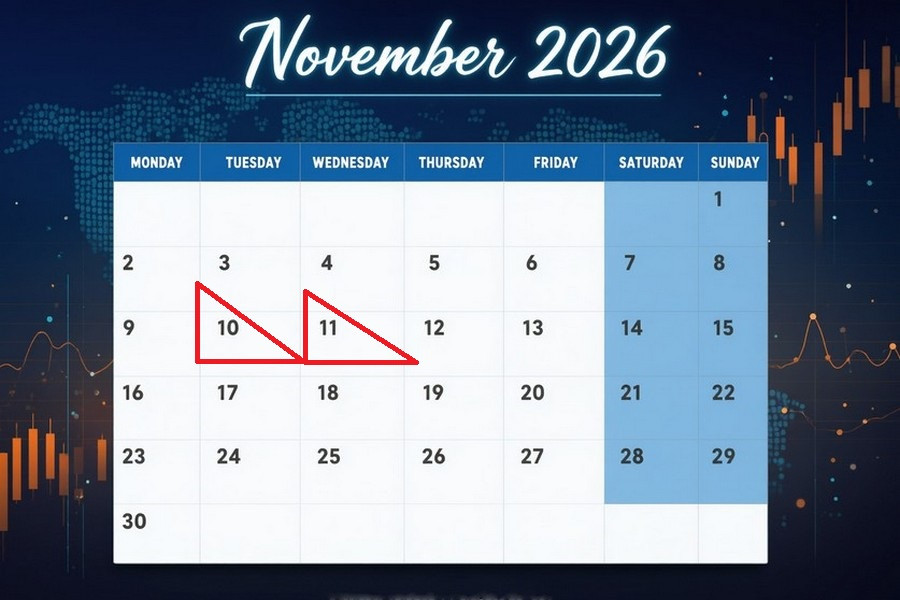
10 November
10 November, 02:30 / Australia / Westpac Consumer Sentiment Index for November (leading) / prev.: -5.2% / actual: -4.7% / forecast: -2.6% / AUD/USD – up
The October Westpac consumer confidence barometer recorded a 4.7% decline, falling to a six-month low of 80.4 points and extending negative momentum for the second month in a row. Households continue to face pressure from:
- high borrowing rates
- higher motor fuel prices
At the same time, the bank's analysts emphasize the realization of pro-inflationary risks and an influx of liquidity from the data-center and AI technology boom, which keeps the possibility of further monetary tightening by the regulator alive. A projected slowing in the decline of consumer confidence against expectations of tougher policy measures will support the Australian dollar.
10 November, 02:30 / Japan / Household spending in September / prev.: -3.6% / actual: -3.1% / forecast: -3.1% / USD/JPY – volatile
In August, Japanese household consumer spending fell by 3.1%, marking the ninth consecutive month of negative dynamics under the influence of persistent inflation. The thriftier spending regime was reflected in notable cuts to:
- education (-12.3%)
- clothing (-8.7%)
- furniture (-6.3%)
- housing (-5.8%)
The decline also affected utilities (-5.2%) and leisure spending (-4.3%), while only the transport segment and communication services showed modest improvement (+0.2%). The protracted contraction in consumer activity continues to point to fragility in domestic demand and constrains the Bank of Japan's ability to normalize interest rates. Continued household restraint in spending will confirm weakness in the consumer base and limit the potential for yen appreciation.
10 November, 03:01 / UK / BRC retail sales in October / prev.: 0.5% / actual: 1.0% / forecast: 1.2% / GBP/USD – up
September's report from the BRC consortium reflected an acceleration in UK retail sales to 1.0%, beating market expectations. Growth was supported by a 2.5% rise in the food segment and strong demand for cosmetics and health products. Accompanying Barclays data recorded a 2.0% increase in consumer spending, with a key driver being a surge in diesel fuel spending (+17.3%). Despite financial confidence rising to 67%, uncertainty over the upcoming government budget is forcing one-third of the population to cut back on discretionary purchases. The expected acceleration in turnover will indicate resilience in household purchasing power and push the British pound higher.
10 November, 03:30 / Australia / NAB Business Confidence Index for October / prev.: -9 pts / actual: -13 pts / forecast: -14 pts / AUD/USD – down
The September business sentiment gauge from NAB fell to -13 points, remaining in negative territory for the seventh consecutive month amid:
- Middle East tensions and
- volatility in oil prices
The deterioration affected 5 of 8 sectors, as input prices continue to outpace selling prices, compressing corporate margins, while the employment subindex plunged to a five-year low. The combination of high capacity utilization with low profitability and cooling hiring increases the risk of a sharper slowdown in the national economy by the end of 2026. Further deterioration in business optimism will heighten recession concerns and put pressure on the Australian dollar.
10 November, 06:00 / China / Trade balance in October / prev.: $119.09bn / actual: $133.53bn / forecast: $125.8bn / USD/CNY – up, Brent – down
China's September trade surplus widened to $133.53 billion, approaching the all-time high recorded in January 2025. Export shipments jumped 36.3%, showing the best seven-month performance thanks to:
- a global boom in AI infrastructure
- frantic demand for microelectronics
Pressure from the US and the EU over excess production capacity has not yet affected the export momentum. Shipments to the US market grew by 39.56%, and the cumulative positive balance for nine months reached $938.11 billion, creating conditions for renewing the annual record of $1.2 trillion. An anticipated contraction in the external trade surplus would signal a localized cooling of the export rally and weaken the Chinese yuan and oil demand.
10 November, 14:00 / US / NFIB Small Business Optimism Index for October / prev.: 98.7 pts / actual: 97.9 pts / forecast: 97.7 pts / USDX (6-currency USD index) – down
In September, the NFIB small business optimism indicator fell to 97.9 points, marking a three-month low amid worsening expectations for future business conditions.
- Of the index's 10 components, 6 showed declines.
- Firms' readiness to undertake investment expansion noticeably weakened.
For the third month in a row, the main problem cited by entrepreneurs is labor shortages (26% of business owners), while 20% named inflationary pressure as the key obstacle. Rising costs and tight credit conditions force businesses to be more cautious in expense planning. The expected slide in small-business optimism will increase concerns about the resilience of activity and trigger profit-taking on the greenback.
10 November, 15:15 / US / ADP four-week average job gains / prev.: 17.5k / actual: 16.75k / forecast: – / USDX (6-currency USD index) – volatile
According to ADP, the four-week average private-sector job gain in the US fell to 16.75k after a 17.5k increase in the previous reporting period. The data reflect the second consecutive slowdown in hiring by commercial enterprises, indicating a gradual cooling in labor demand.
10 November, 16:30 / US / Consumer Price Index (CPI) for October / prev.: 3.4% / actual: 3.7% / forecast: 3.9% / USDX (6-currency USD index) – up
In September, US consumer inflation accelerated to 3.7%. The main catalyst for the price surge was energy, which rose by 5.2%.
- The 9.1% jump in motor gasoline prices accounted for more than half of the total basket increase.
- Housing costs rose by 0.4%.
The core index, excluding food and energy, added 0.3% for the month, confirming a persistent price backdrop in the services sector. Expected strengthening of inflation dynamics will reinforce hawkish monetary policy stances and push US dollar quotations to local peaks.
11 November
11 November, 00:30 / US / API crude oil inventories / prev.: -2.031 mln bbl / actual: -5.267 mln bbl / forecast: – / Brent – volatile
According to the American Petroleum Institute (API), U.S. commercial crude oil stocks fell by 5.267 million barrels over the week, contradicting market estimates for a shift to inventory accumulation. Distillate stocks fell by 270 thousand barrels, while gasoline inventories rose by 1.427 million barrels and volumes at the Cushing terminal increased by 511 thousand barrels. Domestic crude production rose to 13.992 million barrels per day, and the Strategic Petroleum Reserve declined to 282.2 million barrels after another release of 400 thousand barrels. Another large-scale depletion of commercial crude inventories will exacerbate the shortage of physical supply and give a strong upward impulse to Brent crude prices.
11 November, 02:00 / Japan / Reuters Tankan index for manufacturers in November (leading) / prev.: 21 pts / actual: 22 pts / forecast: 23 pts / USD/JPY – down
The leading Reuters Tankan sentiment gauge for large Japanese manufacturers strengthened to 22 points, marking the third consecutive monthly rise and reaching the highest level since December 2021. The industrial upswing was driven by strong demand for semiconductor components and data-center equipment. At the same time, optimism among non-manufacturing firms fell to 23 points due to higher input costs and rising interest rates. Further expected improvement in industrial sentiment will support the Japanese yen.
11 November, 10:00 / Germany / Consumer Price Index (CPI) for October (final) / prev.: 2.9% / actual: 3.3% / forecast: 2.8% / EUR/USD – down
The preliminary estimate recorded a sharp slowdown in inflation in Germany to 2.8% after reaching a three-year high of 3.3% the previous month. Temporary fuel tax discounts were a major factor in the notable easing of price pressures. They slowed the rate of increase in:
- energy to 12.2%
- service-sector tariffs to 2.5%
The core measure fell to 2.1%, and the harmonized EU-standard index dropped to 2.8%, approaching the regulator's 2% target. Final confirmation of the easing inflation backdrop will temper traders' expectations for ECB hawkishness and limit demand for the euro.
10 November, 11:30 / UK / Speech by Bank of England Deputy Governor Sarah Breeden / GBP/USD
10 November, 12:00 / US / Speech by Fed Governor Christopher Waller / USDX
10 November, 15:30 / UK / Speech by Bank of England Deputy Governor Clare Lombardelli / GBP/USD
10 November, 17:00 / Eurozone / Speech by Piero Cipollone, ECB Executive Board / EUR/USD
10 November, 17:35 / US / Speech by Dallas Fed President Lorie Logan / USDX
10 November, 19:45 / Eurozone / Speech by Philip Lane, ECB Governing Council / EUR/USD
10 November, 21:30 / US / Speech by Fed Governor Michelle Bowman / USDX
10 November, 21:30 / US / Speech by Kansas City Fed President Jeffrey Schmid / USDX
10 November, 21:30 / UK / Speech by Hugh Pill from the Bank of England's Monetary Policy Committee / GBP/USD
11 November, 02:30 / US / Speech by Fed Governor Michelle Bowman / USDX
11 November, 10:50 / Eurozone / Speech by Piero Cipollone, ECB Executive Board / EUR/USD
Speeches by senior central bank officials are also scheduled on these days. Their comments typically cause volatility in the currency market, as they can signal regulators' future policy plans on interest rates.


