


The euro lost almost the entire previous day to the dollar. Yesterday the pair rose above 1.1250, and now trades around 1.1161, having given back roughly ninety pips. Overnight it held in a narrow range of 1.1160–1.1170 and went nowhere, and at the low it reached 1.1147.
The cause was US inflation. The consumer-price index shows how much goods and services have risen in price. The headline figure in October rose 0.4% month-on-month versus a 0.3% forecast, and core rose 0.3% versus a 0.2% forecast. Core is needed to understand whether inflation has accelerated inside the economy itself, since food and energy are excluded. In September, the headline printed 0.6% month-on-month, so the pace slowed a bit, but the market expected a stronger slowdown.
The Federal Reserve's reaction was mixed, and that matters for future decisions. Patrick Harker, president of the Philadelphia Fed, favors a gradual pace of hikes. He explains this by saying wage pressure is limited and inflation expectations remain near the 2% target. But Harker is ready to act faster if expectations rise, wages accelerate, or core inflation quickens, and he acknowledges core inflation is above target and not falling. Opposing him are Christopher Waller, who backed a December hike and allowed for a 50-bp move if inflation accelerates, and Loretta Mester (note: earlier references), who sees at least two 25-bp steps. Tom Barkin on November 5 spoke of a gradual pace but on November 9 said risks lie on the price side. In other words, the hawkish tone is growing while cautious voices are in the minority. The fed funds rate stands at 3.75–4.00%, and a December 9 hike is expected.
Today is busy for the euro. Germany's October inflation will be released. For the region's largest economy, a 0.2% monthly decline is expected after a 0.6% rise in September, while the annual rate is expected to slow to 2.8% from 3.3% in September (and 2.9% in August). The harmonized CPI, the comparable EU measure, is also expected at 2.8% year-on-year. If expectations are met, price pressure in Germany will ease, and the European Central Bank will have fewer arguments for further tightening — which would weaken the euro. By contrast, eurozone inflation for October was 4.0% versus 3.8% a month earlier, so prices are accelerating region-wide. That means weak German data would look like an exception rather than a trend.
Next, Italy's industrial production for September will be released; a 1.0% month-on-month rebound is expected after a 1.3% decline. Such a bounce would at least partially soften the picture of weak European data. After that, Bundesbank President Joachim Nagel and ECB President Christine Lagarde will speak. Nagel recently said further steps cannot be ruled out, and Lagarde on October 29 said the council discussed a hike and that the direction is clear to all. If they repeat a hawkish tone, the euro will get support. In my view, only very high German inflation, together with hawkish comments from Nagel and Lagarde, can slow the euro's fall during the European session.
Momentum
The price is now at 1.1161, and a range has formed around it between 1.1138 and 1.1170. A move beyond the boundary is called a breakout, but one touch is not enough — confirmation is needed, meaning several consecutive five-minute candles must close beyond the level. Otherwise, you can easily be caught by a false breakout after which the price returns.
From above 1.1170 is active. A close above opens the way to 1.1193 and then to 1.1218. Overnight, the price approached this mark several times and reversed, so it is already a tested ceiling. To break it, you need a reason, and such a reason could be weak German inflation combined with a hawkish Lagarde. I have little faith in that scenario, since after yesterday's data the dollar remains stronger.
From below, the reference is 1.1138; a close below it leads to 1.1108 and then to 1.1082. I consider this direction primary. It is about twenty-three pips away, and it sits only seven pips above Friday's low of 1.1131, so the price will first bump into this nearby boundary. A breakout is possible if German inflation is below forecast and ECB comments bring no surprises. But remember that many orders often accumulate at the low, so the first test can produce a sharp rebound.
Mean Reversion
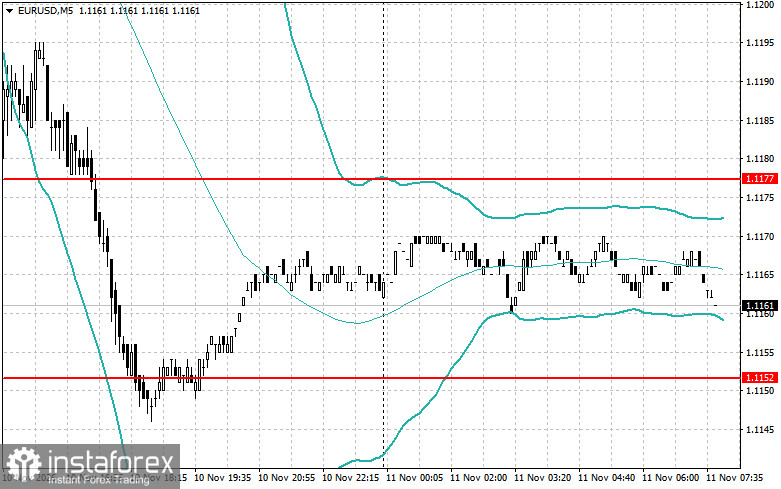
There are two levels here: 1.1177 and 1.1152. The upper reference 1.1177 lies seven pips above the breakout point 1.1170, and a novice needs particular caution here. The scheme is as follows. The price breaks 1.1170, reaches 1.1177, finds no continuation and returns, and then I consider selling. It is sensible to place a stop above 1.1177 with some buffer. But if the price confidently closes above 1.1177, that is a real breakout and selling there is not allowed. It is impossible to distinguish the two scenarios from a single touch, so it is better to skip the first reaction in the zone.
The lower reference 1.1152 lies inside the range, nine pips below the current price and fourteen pips above 1.1138. If the price falls to it, fails to hold below, and returns higher, I look to buy with a stop below 1.1138. Such a pullback is most likely if German inflation prints close to expectations and the market calms after the initial reaction. If the price closes below 1.1152 and then heads to 1.1138, the reversion is canceled, and the downward breakout takes effect.


