


The pound took a heavy hit yesterday and hasn't recovered yet. The GBP/USD pair fell from 1.3458 to 1.3311 during the day, losing about 150 pips.
Yesterday's drop was driven by US inflation. The consumer-price index shows how much the prices of goods and services have risen. The headline figure in October rose 0.4% month-on-month versus a 0.3% forecast, and core rose 0.3% versus a 0.2% forecast. Core is used to determine whether inflation has accelerated within the economy itself since it excludes food and energy. Cautious voices at the Federal Reserve include Patrick Harker, president of the Philadelphia Fed, who favors a gradual pace of hikes, arguing wage pressure is limited, and inflation expectations remain around the 2% target, though he admits core inflation is above target and not falling. On the other side are Christopher Waller, who backed a December hike, and Loretta Mester, who sees at least two 25-bp steps.
Against this backdrop, the Bank of England looks less certain. On November 5 it raised the rate to 4.00%, with all nine committee members voting in favor, whereas in September only three voted for a hike. The tone has markedly hardened. But Andrew Bailey allowed for a second step only if energy prices return to previous levels, and the market prices December as roughly 50/50. The hike itself has long been priced in, but there are no new arguments to support pound buyers.
No UK data are scheduled today, so there are few reasons for the pound to recover. Without fresh numbers, the market will return to yesterday's weak data, and the dollar remains strong after the inflation print. I don't expect the pound to break out under pressure before the end of the European session.
Momentum
Price is now at 1.3343, inside a range between 1.3325 and 1.3353. A move beyond the boundary is a breakout, but one touch isn't enough—confirmation is needed, meaning several consecutive five-minute candles must close beyond the level. Otherwise, you can easily get caught by a false breakout, after which price returns.
From above 1.3353 is active. A close above it opens the way to 1.3377 and then to 1.3404. Overnight, the pair struck this mark several times and reversed down, so it is a tested ceiling. Only an unexpectedly dovish Fed tone could provide a reason to break it, and I have little faith in that scenario.
From below, the reference is 1.3325. A close below it leads to 1.3298 and then to 1.3272. I consider this direction primary. With about eighteen pips to go, the pressure remains strong, and the British side has neither fresh data nor Bank of England comments to stop the fall. Still, remember yesterday's low around 1.3311 lies only fourteen pips from 1.3325 and may attract many buyers, so the first test of the level could produce a sharp rebound.
Mean Reversion
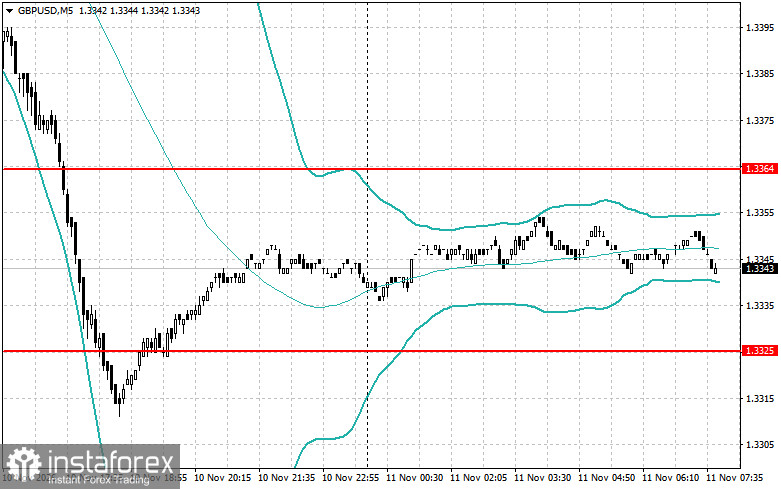
Two levels are in play here: 1.3364 and 1.3325. The upper reference, 1.3364, sits eleven pips above the breakout point, 1.3353. The scheme is this: price breaks 1.3353, reaches 1.3364, finds no continuation, and returns; then I consider selling with a stop above 1.3364, with a small buffer. If the price confidently closes above 1.3364, that is a real breakout and selling there is not allowed.
The lower reference 1.3325 coincides with the breakout point for shorts, and special caution is needed here. The same price serves both as a signal of continuation and as a mark for a reversal, and you cannot tell which scenario has activated on the first touch. If the pair closes below 1.3325, the downward breakout plays and buying is not allowed. If it dips under the level, fails to continue, and quickly returns above, I look to buy with a stop below yesterday's low around 1.3311. It is wiser to skip the first reaction at this point and wait for a clear picture. A reversion is most likely if no new selling reasons appear today and the market starts taking profits after yesterday's drop.


