


















Asian stocks delivered their best day since July on Tuesday. The MSCI Asia Pacific index jumped by 3.8%, breaking an eight-day losing streak that had pushed it close to bear-market territory. Taiwan led the advance, its benchmark up about 9%. TSMC rallied by 9.9%, while Samsung Electronics and SK Hynix gained more than 8%.
The catalyst was Jensen Huang's surprise return to the CEO role at Nvidia. The board had removed him earlier this month, a move that rattled the AI sector amid investor doubts over whether future profits would justify debt-funded capital spending. Recall that on Friday, November 20, Nvidia fell by 14%, the chip index lost 11%, and Donald Trump renewed calls for Huang's reinstatement. On Monday, Wall Street staged its best day since April 2025: Nvidia recorded its strongest one-day advance since 2003, the S&P 500 snapped a seven-day losing streak, and the Nasdaq 100 backed off bear-market territory.
That said, the pressure on equities has not disappeared. European equity futures point to a neutral open, and US index futures were up only about 0.2%, oscillating between gains and losses. Many see Huang's return as a cleansing event, not a definitive reversal. The bounce could be short-lived because government bond yields are falling, a sign that global growth expectations are cooling. Treasuries ticked higher across the curve on Tuesday as oil softened, so the debt market continues to price in a more difficult macro outlook than equities.
US data will be the next mood setter. Tuesday brings the consumer confidence index (Conference Board printed 91.7 in October vs. 84.2 in September). On Wednesday, markets will get the October PCE price index, consumer spending, and the revised Q3 GDP (initially +3.4% annualized). The September PCE price index was 3.6% y/y vs. 3.4% in August. Thursday is Thanksgiving in the US, so liquidity will be thin. These prints will shape expectations for the December 8–9 Fed meeting. Markets price in the funds rate at 3.75–4.00% and expect a 25-bp move in December and likely another in January. On November 23, Williams left the door open to consecutive rate hikes, while Treasury Secretary Bessent warned over the weekend about the risks of over-tightening.
Geopolitics remains a background factor. Over the weekend, Donald Trump said he leans toward resuming strikes on Iran after the New Year if no deal is reached. Iran reportedly struck Bahrain again, and Houthi forces continue attacks on Saudi infrastructure. Last week, Iran launched more missiles and drones than at any point in over a year, so oil markets keep pricing an escalation premium.
Yet oil is drifting lower. Brent eased by 0.5% to roughly $89/bbl, trading below $93 in Asia on November 23 compared with $116.06 on October 30. That marked a decline of more than one-fifth since late October. Gold is holding gains from the prior session near $3,640/oz.
My view is that the risky-asset bounce should persist in the coming days because the main overhang around Nvidia has been removed, and both Asia and Wall Street received a strong impulse. That rally will only be durable if Wednesday's PCE data does not show an acceleration that strengthens the Fed's hike case. Risks remain: bonds and copper point to slowing growth, and the thin holiday week will amplify volatility, so I wouldn't rule out another wave of profit-taking before the weekend.
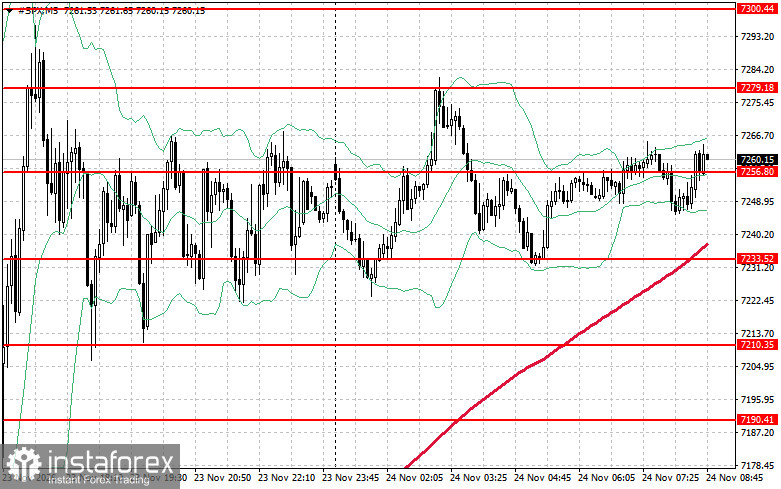
As for S&P 500 technicals, buyers' immediate task is to overcome the resistance level of $7,279. That would confirm upside momentum and open a path to $7,300. Equally important for bulls is to hold above $7,328 to firm buying positions. On any downside move amid falling risk appetite, buyers must defend around $7,256. A break below that level would quickly push the index back to $7,233 and open the way to $7,210.